Recruitment Software in UAE: What Companies Should Look for in 2026
Discover what UAE companies should look for in recruitment software in 2026, including AI screening, candidate matching, automation, Emiratisation support, approval workflows, analytics, integrations, and scalable hiring processes.
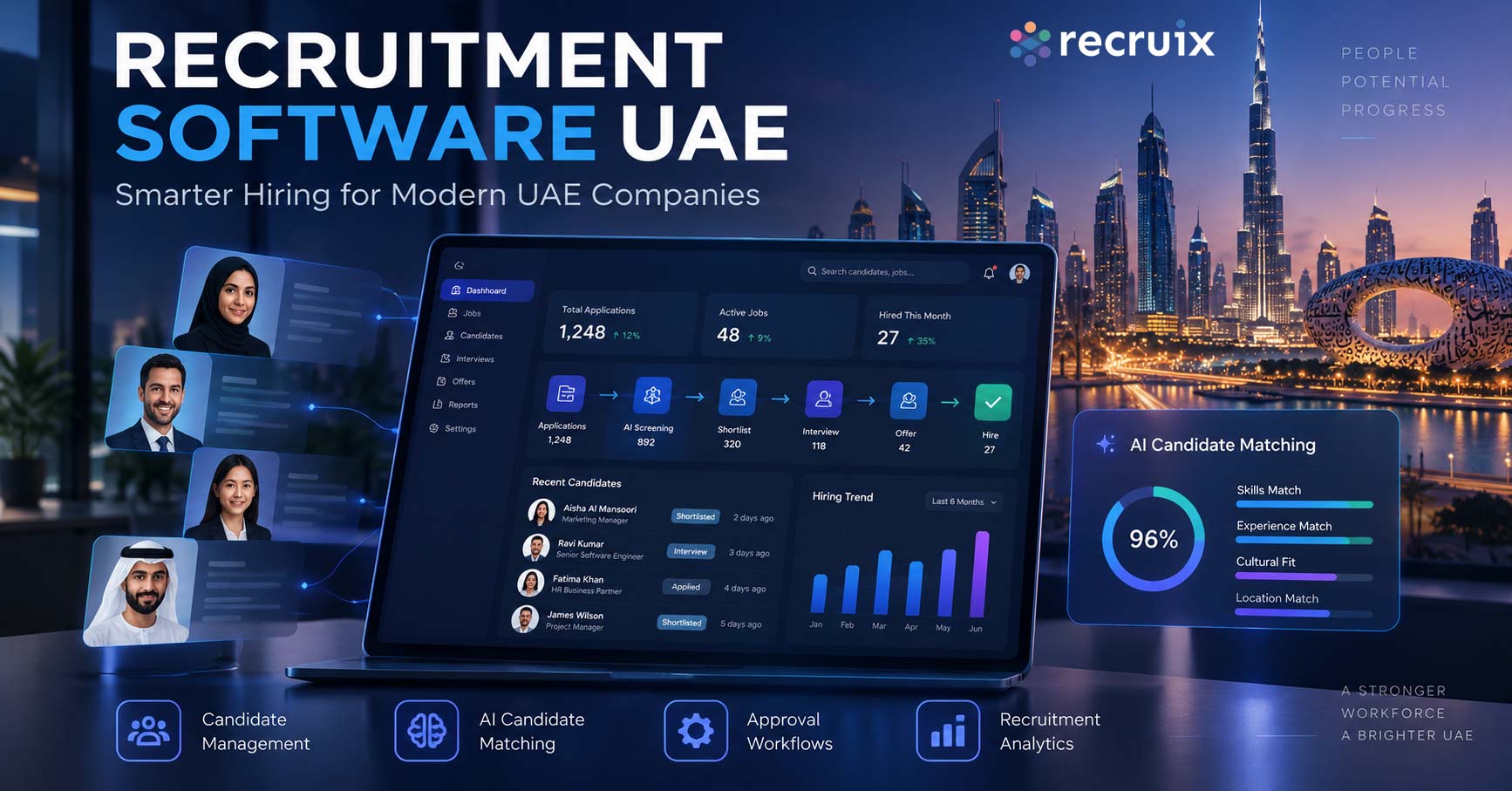
Recruitment in the UAE is changing quickly.
Companies are hiring across increasingly diverse workforces, managing candidates from multiple countries, competing for specialist talent, supporting Emiratisation objectives, and coordinating recruitment across departments, business units, locations, and hiring managers.
At the same time, recruiters are dealing with growing volumes of candidate information.
A single vacancy can generate hundreds of CVs from career portals, job boards, recruitment agencies, referrals, existing candidate databases, and direct applications.
This makes recruitment software much more than a place to store resumes.
For UAE companies evaluating recruitment software in 2026, the important question is not simply:
“Does this system have an applicant tracking system?”
The better question is:
“Can this platform support the way our organization actually hires?”
This guide explains what UAE employers should look for when evaluating recruitment software, from applicant tracking and AI candidate matching to approval workflows, Emiratisation visibility, analytics, integrations, security, and recruitment automation.
What Is Recruitment Software?
Recruitment software is technology used to manage and improve activities across the hiring lifecycle.
Depending on the platform, recruitment software can help organizations manage:
Job requisitions
Job approval workflows
Vacancies
Candidate applications
CV and resume parsing
Candidate databases
AI-assisted screening and matching
Shortlisting
Interviews
Hiring manager collaboration
Offer approvals
Offer letters
Candidate communication
Onboarding documentation
Recruitment analytics
Recruiter performance
An Applicant Tracking System (ATS) typically forms the operational foundation of this environment by helping organizations manage candidates, applications, jobs, and recruitment workflows.
Modern recruitment platforms increasingly extend beyond traditional applicant tracking by adding automation, analytics, integrations, and artificial intelligence.
Why Recruitment Software Matters for UAE Companies
The UAE has a highly international labour market and a diverse private sector spanning industries such as construction, real estate, hospitality, healthcare, retail, financial services, logistics, technology, manufacturing, and professional services.
Recruitment requirements can therefore vary considerably between organizations.
A hospitality group recruiting hundreds of operational employees may have very different requirements from a financial institution hiring specialist professionals or a construction company coordinating recruitment across multiple projects.
Large UAE organizations may also need recruitment processes involving several levels of approval before a job is opened or an offer is released.
This means recruitment technology should be flexible enough to support the organization's actual hiring structure rather than forcing every employer into the same workflow.
Understanding the UAE Employment Environment
Recruitment technology operates alongside the UAE's employment and government processes; it does not replace them.
Private-sector employment in the UAE is governed by Federal Decree-Law No. 33 of 2021 Regarding the Regulation of Employment Relationships and its amendments. The Official Platform of the UAE Government identifies the Ministry of Human Resources and Emiratisation (MoHRE) as the competent authority responsible for regulating employer-employee relations in the private sector.
Employers should therefore distinguish between two different technology layers:
Recruitment software manages the organization's internal hiring process.
Government systems and processes manage statutory employment requirements such as applicable work permits and employment procedures.
A good recruitment platform helps an organization manage the journey toward hiring while maintaining the information, approvals, documentation, and visibility required internally.
Organizations should continue to follow the applicable requirements and services provided by the Ministry of Human Resources and Emiratisation (MoHRE) and other relevant UAE authorities.
What Should UAE Companies Look for in Recruitment Software?
There is no single feature that determines whether a recruitment platform is right for an organization.
Instead, UAE employers should evaluate how well the system supports the complete hiring process.
1. Applicant Tracking
A strong ATS should provide a central environment for managing jobs, candidates, applications, and recruitment activity.
Recruiters should be able to understand:
Which candidates applied for each position
Where candidates are within the recruitment process
Which recruiter owns an application
Previous interactions with the candidate
Interview history
Application status
Offer activity
Relevant documents and notes
This creates a single source of recruitment information rather than distributing candidate data across spreadsheets, inboxes, folders, and individual recruiter records.
2. Strong Candidate Database Management
Candidate databases become increasingly valuable as organizations grow.
A candidate who was not selected for one vacancy may be highly relevant to another opportunity several months later.
Recruitment software should therefore make it easy to search, filter, rediscover, and reuse existing candidate information where appropriate.
This is especially important for recruitment agencies and organizations with continuous hiring requirements.
3. Fast CV Parsing and Candidate Processing
Recruiters should not need to manually copy every candidate's employment history, education, skills, and contact information from a CV into an ATS.
Resume or CV parsing can transform information contained in uploaded documents into structured candidate data.
For high-volume recruitment teams, the ability to process multiple CVs efficiently can significantly reduce repetitive administration.
Organizations evaluating recruitment software should consider both individual and bulk candidate processing capabilities.
4. AI Resume Screening
Receiving applications is rarely the problem.
Understanding which applications deserve recruiter attention is much harder when hundreds of candidates apply.
AI resume screening can help recruitment teams analyze candidate information and prioritize potentially relevant applicants for recruiter review.
However, organizations should look beyond a simple AI score.
Recruiters should understand what information contributes to candidate recommendations and retain appropriate human oversight.
AI should support recruitment decisions rather than becoming an unexplained replacement for recruiter judgment.
5. AI Candidate Matching
Traditional candidate searches often depend heavily on keywords.
More advanced AI candidate matching can compare candidate information with job requirements across multiple attributes such as skills, experience, qualifications, industry background, and other role-specific criteria.
This can help recruiters answer an important question:
“Who in our candidate database appears most relevant to this job?”
Useful matching technology should also explain why a candidate appears relevant rather than displaying a percentage without context.
6. Recruitment Workflow Automation
Recruiters perform many repetitive activities throughout the hiring process.
These may include:
Candidate acknowledgement emails
Interview notifications
Internal reminders
Approval requests
Status notifications
Follow-up communication
Task creation
Offer communication
Recruitment automation can reduce this administrative workload and help teams maintain more consistent processes.
The objective should not be to remove human interaction from recruitment.
It should be to reduce repetitive administration so recruiters have more time for candidate conversations, interviews, hiring managers, and decision-making.
7. Multi-Level Job Approval Workflows
Job creation in a large organization may require approval from multiple stakeholders.
Depending on organizational structure, this might involve:
Recruiter → Hiring Manager → Department Head → HR → Senior Management
Recruitment software should allow organizations to configure approval workflows that reflect their actual structure.
Important capabilities may include:
Multiple approval levels
Department-specific approvers
Configurable approval sequences
Approval notifications
Approval history
Audit trails
Role-based permissions
This becomes particularly important for enterprise organizations managing recruitment across numerous departments or business units.
8. Offer Approval and Offer Management
Approval requirements do not necessarily end when a candidate is selected.
Offers may require approval based on factors such as department, position, grade, compensation, business unit, or organizational policy.
A recruitment platform should help organizations structure these processes while maintaining visibility into who approved an offer and when.
According to the UAE Government's guidance on job offers and the employment process, private-sector employment involves a formal job offer, employment contract, work permit, and subsequent employment procedures.
Internal ATS offer workflows should therefore be understood as part of the employer's recruitment process, while statutory employment processes remain subject to applicable UAE requirements.
9. Emiratisation Visibility
Emiratisation is an important consideration for many UAE private-sector employers.
The UAE's Emiratisation framework includes the Nafis programme and requirements that vary according to applicable employer categories and regulations.
The Official UAE Government guidance on employing Emiratis in the private sector provides current information on employer obligations and related requirements.
Recruitment software does not replace MoHRE or Nafis.
However, organizations may benefit from internal recruitment visibility that helps them monitor hiring activity involving Emirati candidates.
Depending on organizational requirements, useful capabilities could include:
Candidate nationality information where lawfully collected and appropriate
Emirati candidate pipelines
Recruitment reports
Vacancy tracking
Department-level hiring visibility
Candidate source tracking
Configurable dashboards
Employers should configure recruitment processes and candidate-data handling according to applicable law and internal policy.
10. Recruitment Analytics
Recruitment leaders need more than a list of open vacancies.
Useful recruitment analytics can help organizations understand:
Time-to-hire
Candidate pipeline movement
Application volumes
Candidate sources
Recruiter activity
Interview progression
Offer activity
Hiring bottlenecks
Job status
The objective is to turn recruitment data into information that HR leaders can use to understand and improve the hiring process.
11. Recruitment Agency Capabilities
Recruitment agencies have additional requirements because they may simultaneously manage multiple clients, jobs, recruiters, candidate submissions, interviews, offers, and placements.
Agencies should consider capabilities such as:
Large candidate database management
Bulk CV processing
Candidate-to-job relationships
AI candidate matching
Recruiter ownership
Client-ready candidate presentation
Interview tracking
Offer and placement management
Recruitment analytics
For a more detailed evaluation, read our guide to choosing an ATS for recruitment agencies.
12. Integration With Existing HR Technology
Recruitment software rarely operates completely independently.
Organizations may need to connect recruitment with systems such as:
HRMS or HCM platforms
Email systems
Calendars
Video interviewing tools
Identity systems
Job distribution platforms
Internal business applications
Enterprise organizations should therefore evaluate APIs, integration capabilities, authentication, data synchronization, and how candidate information moves into downstream HR processes after hiring.
13. Role-Based Access and Organizational Hierarchy
Not every user should necessarily have access to every candidate, job, offer, or recruitment action.
Recruitment platforms should support appropriate access controls for roles such as:
Recruiters
Senior recruiters
Hiring managers
Department heads
HR leadership
Administrators
Organizations with multiple legal entities, departments, locations, or business units should also evaluate whether the platform can represent their organizational hierarchy appropriately.
14. Security, Auditability and Candidate Data
Recruitment systems contain significant amounts of personal candidate information.
Organizations should therefore evaluate security as a core procurement requirement rather than an optional feature.
Questions should include:
How is candidate data protected?
What access controls are available?
Are user actions auditable?
Can permissions be configured?
How are integrations authenticated?
What data retention controls exist?
How are AI-assisted recommendations governed?
Organizations should assess these capabilities against their legal, regulatory, security, and internal governance requirements.
Does Recruitment Software Replace MoHRE Systems?
No.
An ATS or recruitment platform manages an employer's internal recruitment activities. It does not replace MoHRE, UAE Government systems, work permit processes, employment contracts, visa procedures, or other statutory requirements.
The UAE Government states that employers may not recruit or employ a worker without the applicable work permit issued in accordance with MoHRE procedures.
The Government's work permit guidance also explains the Work Bundle initiative, which consolidates several government employment-related processes.
The distinction is straightforward:
Recruitment software helps you manage who and how you hire.
Government platforms manage applicable statutory employment processes.
ATS vs Recruitment Software: What Is the Difference?
The terms are frequently used interchangeably.
An ATS traditionally focuses on managing jobs, candidates, applications, and recruitment stages.
Recruitment software can describe a broader technology environment that may include:
Applicant tracking
AI-assisted candidate intelligence
Recruitment automation
Approvals
Interview management
Offer management
Analytics
Integrations
Career portals
Onboarding workflows
The important question is therefore not what the vendor calls the product.
Organizations should evaluate whether the platform actually supports their recruitment requirements.
Can AI Improve Recruitment in the UAE?
AI can be useful when it solves specific recruitment problems.
For example, organizations receiving large numbers of applications may use AI-assisted technology to help process candidate information, identify relevant profiles, compare candidates with job requirements, and prioritize recruiter attention.
Our guide to AI in recruitment explains these applications in greater detail.
However, organizations should avoid evaluating recruitment AI based only on whether a vendor displays an “AI-powered” label.
Important questions include:
What information does the AI analyze?
Why did a candidate receive a particular recommendation?
Can recruiters review the underlying candidate information?
Can recommendations be overridden?
Is appropriate human oversight maintained?
Are AI-related actions sufficiently auditable for the organization's requirements?
The strongest use of AI in recruitment is often not replacing recruiters.
It is helping recruiters process information more effectively so they can make informed decisions faster.
What Recruitment Software Is Suitable for High-Volume Hiring in the UAE?
Organizations recruiting at scale should pay particular attention to operational capacity.
This may include employers in hospitality, retail, construction, logistics, healthcare, staffing, and other industries with recurring or high-volume recruitment requirements.
Useful capabilities include:
Bulk CV processing
Resume parsing
AI-assisted screening
Candidate matching
Bulk candidate actions
Automated communication
Configurable pipelines
Recruiter collaboration
Candidate database search
Recruitment analytics
The platform should help recruiters manage increasing application volumes without requiring the recruitment team to increase repetitive administrative work at the same rate.
How Should UAE Companies Evaluate Recruitment Software?
Before requesting demonstrations, organizations should document how recruitment currently works.
A useful evaluation checklist includes:
How many employees, recruiters, departments, and business units will use the system?
How many vacancies are typically active?
How many applications are processed each month?
How are jobs approved?
How are candidates screened?
How are interviews coordinated?
Who approves offers?
What reports does management require?
Which systems need to integrate with recruitment?
What permissions and audit requirements exist?
Does the organization require high-volume or bulk candidate processing?
How should AI recommendations be reviewed?
What candidate experience should the career portal provide?
What UAE-specific reporting or hiring visibility is required?
Then ask vendors to demonstrate those workflows using realistic scenarios.
A polished dashboard is useful.
A platform that can actually support the organization's recruitment process is more important.
How Recruix Supports Recruitment Teams in the UAE
Recruix is an AI-powered recruitment platform and Applicant Tracking System designed to bring candidate management, recruitment workflows, AI-assisted matching, approvals, interviews, offers, onboarding, and recruitment analytics into one connected environment.
Recruix supports recruitment teams with capabilities including:
Applicant tracking
Candidate database management
CV parsing
AI-assisted candidate matching and ranking
Configurable recruitment pipelines
Multi-level job approvals
Offer approval workflows
Role-based permissions
Organizational hierarchy
Interview management
Automated candidate communication
Offer management
Onboarding workflows
Recruitment analytics
Career portals
Enterprise integrations and APIs
The objective is to give recruitment teams a structured environment for managing the complete hiring lifecycle while using AI and automation to reduce repetitive work and help recruiters identify relevant talent more efficiently.
Frequently Asked Questions About Recruitment Software in the UAE
What is recruitment software?
Recruitment software helps organizations manage activities such as jobs, candidate applications, CV processing, screening, interviews, approvals, offers, communication, and recruitment analytics through a structured digital platform.
What is the best recruitment software for UAE companies?
There is no single recruitment platform that is automatically best for every UAE company. The right software depends on factors such as hiring volume, organizational structure, approval requirements, candidate sources, integrations, security requirements, reporting needs, and whether the organization requires capabilities such as AI screening, candidate matching, or high-volume recruitment.
What should UAE companies look for in an ATS?
UAE employers should consider candidate management, CV parsing, configurable workflows, job and offer approvals, AI-assisted screening and matching, interview management, analytics, integrations, access controls, auditability, career portals, and the platform's ability to support the organization's structure and hiring volume.
Can recruitment software help with Emiratisation?
Recruitment software can provide internal visibility into relevant recruitment pipelines, candidate information, vacancies, sources, and hiring activity where configured appropriately. It does not replace MoHRE, Nafis, or government Emiratisation systems and requirements.
Does an ATS integrate directly with MoHRE?
An ATS should not be assumed to integrate with MoHRE unless the software provider specifically offers and documents such an integration. Recruitment software primarily manages internal hiring workflows, while statutory employment processes remain subject to applicable UAE Government and MoHRE procedures.
Can AI screen CVs?
AI-enabled recruitment software can analyze candidate information and help recruiters identify applications that appear relevant to job requirements. AI screening should support recruiter review rather than automatically replacing human hiring judgment.
What is AI candidate matching?
AI candidate matching compares candidate information with job requirements across attributes such as skills, experience, qualifications, and other role-related criteria to help recruiters identify potentially relevant candidates.
Is recruitment software useful for recruitment agencies in Dubai?
Yes. Recruitment agencies can use recruitment software to manage candidate databases, multiple vacancies, candidate-job relationships, recruiter ownership, CV processing, matching, interviews, client submissions, offers, placements, and recruitment analytics.
Can an ATS manage multi-level approval workflows?
Some enterprise recruitment platforms support configurable multi-level approval workflows for job requisitions and offers. Organizations with complex hierarchies should verify whether approval chains can reflect their departments, business units, roles, and internal policies.
Does recruitment software replace recruiters?
No. Recruitment technology can reduce repetitive administrative work, organize candidate information, support candidate discovery, and automate selected workflows. Human recruiters remain essential for understanding hiring requirements, evaluating context, interviewing candidates, managing stakeholders, and making hiring decisions.
Does recruitment software replace MoHRE or UAE Government employment systems?
No. Recruitment software manages an organization's internal recruitment process. Employers must continue to follow applicable UAE employment, work permit, contract, Emiratisation, and other government requirements through the appropriate authorities and systems.
Choosing Recruitment Software for the UAE in 2026
Recruitment technology is moving beyond simply storing CVs and tracking applications.
Modern recruitment teams increasingly need systems that can help them understand candidate information, automate repetitive processes, coordinate complex approval workflows, maintain visibility across hiring teams, and turn recruitment data into useful intelligence.
For UAE companies, the right recruitment platform should combine these capabilities with enough flexibility to support the organization's structure, industry, hiring volume, and internal processes.
The objective is not to automate recruitment for the sake of automation.
It is to create a hiring environment where technology handles more of the repetitive processing while recruiters and hiring managers retain the context, relationships, and judgment required to make strong hiring decisions.
Ready to Modernize Your Recruitment Process?
See how Recruix can help your recruitment team manage candidates, automate hiring workflows, use AI-assisted candidate intelligence, coordinate approvals, and manage recruitment from job requisition through onboarding.
The Recruix team shares practical guidance for smarter, more effective hiring.
Stay Ahead of the Future of Hiring
Get recruitment insights, AI hiring trends, and workforce intelligence delivered directly to your inbox.
Ready to Transform Your Hiring Process?
See how Recruix helps organizations hire smarter through AI-powered recruitment intelligence.
Book Demo