AI Resume Screening: How It Works and Why Modern Recruitment Teams Need It
Learn how AI resume screening helps recruitment teams analyze large applicant volumes, identify relevant candidates faster, reduce manual screening, and make more informed hiring decisions.
AI Resume Screening: How It Works and Why Modern Recruitment Teams Need It
Recruiters today are often expected to do more with less time.
A single job opening can attract hundreds of applications, especially when roles are advertised across job boards, career sites, recruitment agencies, and professional networks. Reviewing every CV manually can quickly become one of the most time-consuming parts of the hiring process.
This is where AI resume screening is becoming increasingly valuable.
Instead of forcing recruiters to open and evaluate every application one by one, AI-enabled recruitment technology can help analyze candidate information, identify potentially relevant profiles, and prioritize where recruiters should focus their attention.
In this article, we explain how AI resume screening works, how it differs from traditional keyword screening, what recruiters should look for in an AI screening system, and where human judgment still matters.
What Is AI Resume Screening?
AI resume screening is the use of artificial intelligence to analyze resumes or CVs and help recruitment teams identify candidates whose profiles appear relevant to a specific job.
The technology may assess information such as:
- Professional experience
- Skills
- Education
- Qualifications
- Job titles
- Industry background
- Career history
- Role-specific requirements
The objective is not simply to reject candidates automatically. A well-designed AI screening process should help recruiters organize, prioritize, and understand large applicant pools more efficiently.
Why Manual Resume Screening Becomes Difficult at Scale
Manual screening can work reasonably well when a job receives a small number of applications.
The challenge begins when application volume increases.
Imagine a recruiter managing five vacancies, each receiving 200 applications.
That is 1,000 resumes to review.
If a recruiter spends just two minutes reviewing each CV, that would already require more than 33 hours of screening time before interviews, hiring manager discussions, candidate communication, scheduling, approvals, and other recruitment tasks even begin.
For high-volume recruitment teams, the problem is not necessarily a lack of applicants.
The problem is identifying the right candidates quickly enough.
This is one reason organizations increasingly look toward AI in recruitment to help recruitment teams process information more efficiently.
How Does AI Resume Screening Work?
Different recruitment platforms use different technologies, but the process generally involves several stages.
1. Resume Parsing
The first step is usually extracting structured information from a candidate's resume.
A resume parser may identify information such as:
- Name and contact information
- Employment history
- Job titles
- Skills
- Education
- Certifications
- Years of experience
This converts an unstructured document into information that a recruitment platform can process and organize.
2. Understanding the Job Requirements
The system must also understand what the vacancy requires.
This can include:
- Required skills
- Preferred skills
- Experience requirements
- Education or certifications
- Relevant industry experience
- Seniority level
- Other job-specific criteria
The quality of the job description and hiring criteria can significantly influence the usefulness of candidate screening results.
3. Comparing Candidates With the Job
The AI can then compare candidate information against the requirements of the role.
Rather than treating every resume equally, the platform can help determine which profiles appear more closely aligned with what the hiring team is looking for.
4. Ranking or Prioritizing Candidates
After analyzing applications, an AI-enabled system may assign match indicators, scores, categories, or rankings.
This allows recruiters to review potentially stronger candidates first instead of manually working through applications in the order they were received.
Candidate ranking should be treated as decision support, not as the final hiring decision.
AI Resume Screening vs Keyword Screening
Traditional recruitment systems have often relied heavily on keyword searches.
For example, a recruiter searching for a Python developer might search for resumes containing terms such as “Python,” “Django,” or “REST API.”
Keyword matching can still be useful, but it has limitations.
A candidate may have relevant experience without using exactly the same terminology as the job description. Conversely, a resume may contain a keyword without demonstrating meaningful experience with that skill.
AI-assisted screening can potentially evaluate a broader context around a candidate's profile rather than simply checking whether a word appears in a document.
This distinction is important.
Finding a keyword is not the same as understanding candidate relevance.
What Information Can AI Resume Screening Evaluate?
Depending on the recruitment platform and configuration, AI screening may consider multiple candidate attributes.
Skills
The system can compare candidate skills with the skills required for a role.
Professional Experience
Relevant employment history, responsibilities, and career progression can help indicate whether a candidate has experience related to the vacancy.
Job Titles and Seniority
Previous titles may help the system understand whether the candidate's professional background aligns with the expected seniority level.
Education and Certifications
Where qualifications are relevant to the position, education and certifications may contribute to candidate evaluation.
Industry Experience
Some positions may benefit from prior experience in a particular industry, market, or business environment.
Role-Specific Requirements
Organizations may also define additional screening criteria depending on the vacancy.
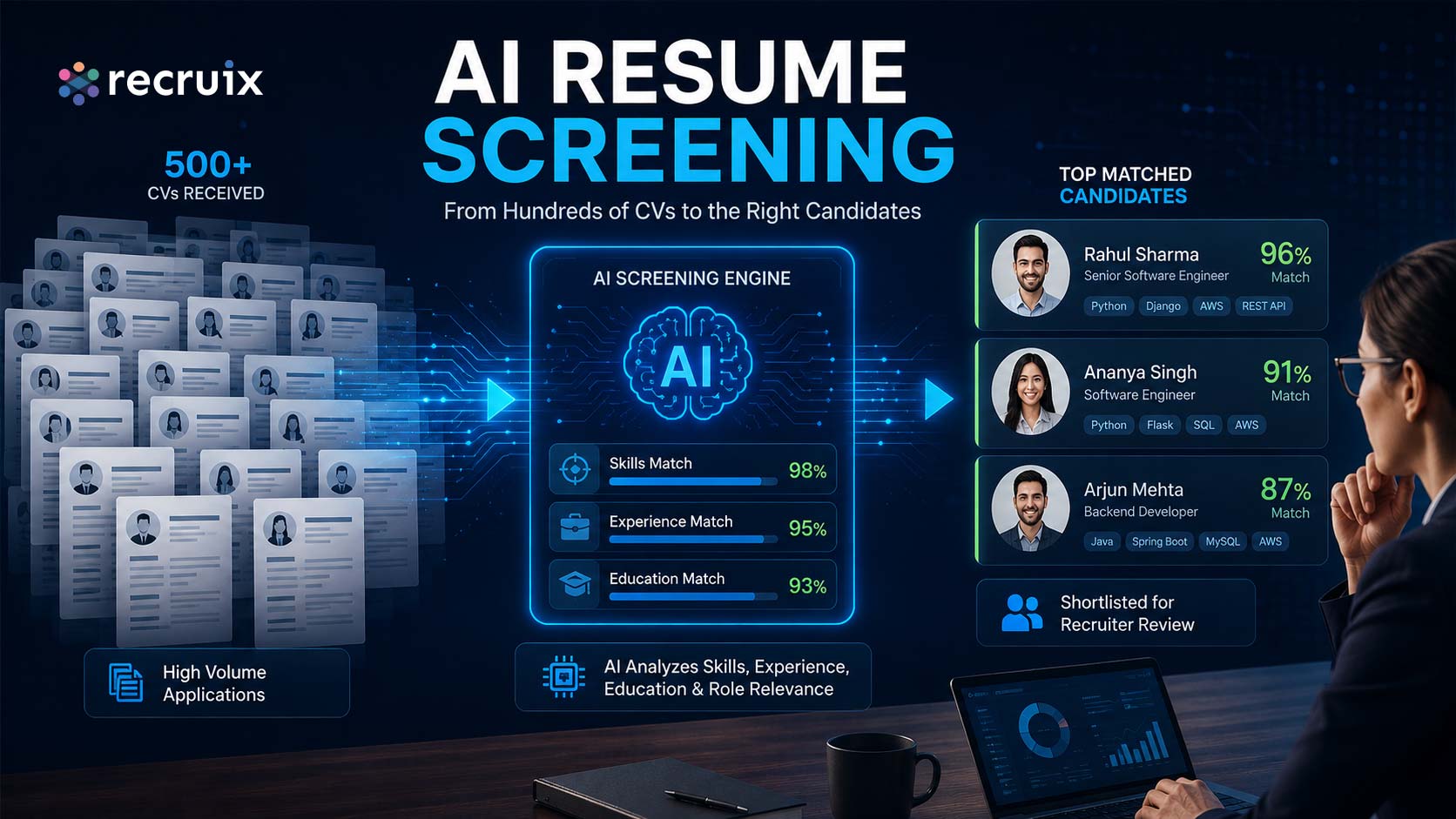
What Happens When 500 CVs Arrive for One Job?
This is where AI resume screening becomes particularly useful.
Without screening technology, recruiters may need to manually open hundreds of applications before identifying the strongest candidates.
With an AI-assisted process, the recruitment platform can first analyze the applicant pool and help organize candidates based on job relevance.
A recruiter might then see:
- Highly relevant candidates
- Potential matches requiring review
- Candidates with partial alignment
- Profiles that do not meet essential requirements
Instead of replacing the recruiter, the technology changes the order in which the recruiter spends time.
The recruiter's attention can move toward the candidates most likely to deserve detailed human review.
What Are the Benefits of AI Resume Screening?
Faster Initial Screening
AI can help recruitment teams process large volumes of applications faster than a completely manual workflow.
Reduced Administrative Work
Recruiters can spend less time opening and sorting resumes and more time speaking with candidates and hiring managers.
Faster Candidate Response
When recruitment teams identify relevant candidates sooner, they may also be able to move strong applicants through the hiring process faster.
More Structured Evaluation
Using defined job criteria can help provide a more structured starting point for candidate review.
Better Use of Recruiter Time
AI screening helps redirect recruiter attention from document processing toward higher-value recruitment activities.
AI Screening Is Not the Same as AI Candidate Matching
Resume screening and candidate matching are closely related, but they are not exactly the same.
Resume screening generally focuses on analyzing incoming applications and helping determine which candidates warrant further review.
Candidate matching goes further by evaluating how closely a candidate aligns with a particular job.
This can involve comparing multiple candidate and job attributes to create a more complete view of potential suitability.
We will explore this in greater detail in our upcoming guide to AI candidate matching.
How AI Resume Screening Works Within an ATS
An Applicant Tracking System manages jobs, candidates, applications, recruitment stages, interviews, offers, and related hiring workflows.
When AI screening is integrated into the ATS, recruiters do not need to move between separate tools to analyze candidates and manage the recruitment process.
Applications can enter the system, be analyzed, prioritized, reviewed, and progressed through the same recruitment environment.
This is particularly valuable for organizations managing multiple jobs, recruiters, departments, and hiring managers.
Can AI Resume Screening Reduce Time-to-Hire?
Resume screening is only one part of the recruitment lifecycle, so AI screening alone cannot solve every hiring delay.
However, initial candidate review can be a significant bottleneck when application volumes are high.
Reducing the time required to identify relevant candidates can help recruitment teams begin interviews and hiring discussions sooner.
The greatest impact usually comes when screening is combined with broader recruitment automation, efficient approval processes, interview coordination, candidate communication, and structured workflows.
Does AI Resume Screening Replace Recruiters?
No.
AI can process information, identify patterns, organize applications, and provide recommendations.
But recruitment decisions involve context that technology may not fully understand.
Recruiters still need to evaluate areas such as:
- Candidate motivation
- Communication
- Career goals
- Team requirements
- Role expectations
- Stakeholder feedback
- Interview performance
The strongest model is therefore not AI instead of recruiters.
It is recruiters working with AI.
What Are the Risks of AI Resume Screening?
Organizations should also evaluate AI recruitment technology responsibly.
Potential concerns include data quality, privacy, security, explainability, inappropriate screening criteria, and algorithmic bias.
The NIST AI Risk Management Framework provides organizations with a voluntary framework for managing risks associated with artificial intelligence and promoting trustworthy AI practices.
Recruitment teams should maintain appropriate human oversight, periodically review screening criteria, and ensure that automated recommendations do not become unquestioned hiring decisions.
What Should Recruiters Look for in AI Resume Screening Software?
Recruitment teams evaluating AI screening technology should look beyond marketing claims.
Important questions include:
- Does the platform explain why a candidate is considered relevant?
- Can recruiters control or configure job criteria?
- Does screening integrate directly with the ATS?
- Can recruiters review the complete candidate profile?
- Does the system support large applicant volumes?
- Can candidate information be updated and managed easily?
- Are access controls and candidate data protected?
- Is there appropriate human oversight?
AI should help recruiters make better use of their time rather than creating another system they need to manage.
How Recruix Approaches AI Resume Screening
Recruix brings candidate management, applicant tracking, recruitment workflows, and AI-assisted candidate intelligence into one recruitment platform.
Recruitment teams can manage candidate applications, process CVs, identify relevant talent, and progress candidates through the hiring lifecycle without relying on disconnected tools.
The objective is not to remove recruiters from the process.
It is to help them reach the right candidates sooner.
Less manual screening. Faster decisions. Better hiring.
The Future of Resume Screening
Resume screening is moving from simple document filtering toward more intelligent candidate understanding.
Recruitment technology will increasingly be expected to help recruiters understand candidate relevance, explain recommendations, support hiring workflows, and provide useful information at the moment decisions are being made.
At the same time, responsible use of AI will become increasingly important.
Organizations that combine intelligent recruitment technology with human judgment are likely to gain the greatest value from AI screening.
Frequently Asked Questions About AI Resume Screening
What is AI resume screening?
AI resume screening uses artificial intelligence to analyze candidate resumes and help recruiters identify applicants whose skills, experience, and qualifications appear relevant to a job.
How does AI screen CVs?
AI screening systems generally extract information from a CV, analyze job requirements, compare candidate attributes with those requirements, and help prioritize candidates for recruiter review.
Is AI resume screening better than keyword matching?
Keyword matching identifies specific words or phrases, while more advanced AI screening can consider broader candidate and job context. The effectiveness depends on the technology, data, and screening criteria being used.
Can AI automatically reject candidates?
Some systems may support automated workflows, but organizations should maintain appropriate human oversight when technology influences employment decisions.
Can AI screen hundreds of resumes?
Yes. One of the main advantages of AI-assisted screening is its ability to process large applicant volumes more efficiently than fully manual resume review.
Does AI resume screening replace an ATS?
No. AI screening is usually most useful as an intelligent capability within or connected to an Applicant Tracking System that manages the broader recruitment lifecycle.
Will AI replace recruiters?
AI is more likely to reduce repetitive processing work than replace recruiters. Human judgment, interviews, candidate relationships, stakeholder management, and final hiring decisions remain important parts of recruitment.
Ready to See AI Resume Screening in Action?
Discover how Recruix can help your recruitment team process applications, identify relevant candidates faster, and manage the complete hiring journey through one connected recruitment platform.
The Recruix team shares practical guidance for smarter, more effective hiring.
Stay Ahead of the Future of Hiring
Get recruitment insights, AI hiring trends, and workforce intelligence delivered directly to your inbox.
Ready to Transform Your Hiring Process?
See how Recruix helps organizations hire smarter through AI-powered recruitment intelligence.
Book Demo