AI Candidate Matching: How It Works Beyond Keyword Matching
Learn how AI candidate matching goes beyond simple keyword searches to evaluate skills, experience, qualifications, and job requirements—helping recruiters identify stronger candidates faster.
AI Candidate Matching: How It Works Beyond Keyword Matching
Finding candidates is rarely the hardest part of recruitment anymore.
The harder question is: which candidates are actually the right fit for the job?
A recruiter may have hundreds or even thousands of profiles available across an applicant tracking system, existing talent database, job applications, referrals, and other sourcing channels. Searching that information manually can take considerable time.
Traditional recruitment technology helped solve part of this problem through keyword searches and filters.
Artificial intelligence is taking candidate discovery further.
AI candidate matching can analyze multiple dimensions of a candidate profile alongside the requirements of a job to help recruiters identify candidates who appear more relevant to a particular opportunity.
But candidate matching is frequently misunderstood. A percentage beside a candidate's name does not automatically mean that artificial intelligence understands whether someone should be hired.
In this guide, we explain how AI candidate matching works, how it differs from keyword matching, what a meaningful match score should represent, and why human judgment remains essential.
What Is AI Candidate Matching?
AI candidate matching is the use of artificial intelligence to compare information about a candidate with the requirements of a job and determine areas of alignment or potential gaps.
Depending on the recruitment platform, matching may consider information such as:
- Required and preferred skills
- Years and type of professional experience
- Previous roles and responsibilities
- Education and qualifications
- Certifications
- Industry experience
- Seniority level
- Location or work requirements
- Other role-specific criteria
The objective is to help recruiters understand candidate relevance more efficiently—not to make the final hiring decision automatically.
Why Traditional Keyword Matching Has Limitations
Keyword searching has been useful in recruitment technology for many years.
Suppose a company is hiring a backend developer and the recruiter searches for:
Python + Django + AWS
A traditional search can quickly identify resumes containing those words.
But the presence of a keyword does not necessarily establish expertise.
One candidate might mention AWS once because they participated in a project involving it. Another may have spent four years designing and maintaining AWS infrastructure.
Both resumes contain the same keyword.
Their experience is clearly not identical.
The opposite problem can also occur. A strong candidate may describe relevant experience using terminology different from the wording used in the job description.
This is why effective candidate matching needs to consider more than whether particular words appear in a CV.
How Does AI Candidate Matching Work?
The exact methodology differs between recruitment platforms, but AI candidate matching generally involves understanding information from both sides of the hiring equation:
the job and the candidate.
1. Understanding the Job
The first step is identifying what the organization is actually looking for.
This may involve analyzing:
- Job title
- Job description
- Required skills
- Preferred skills
- Minimum experience
- Education requirements
- Certifications
- Industry requirements
- Location
- Other hiring criteria
This is important because even sophisticated matching technology cannot compensate completely for unclear or inaccurate job requirements.
2. Understanding the Candidate
The system then needs structured candidate information.
This often begins with resume or CV parsing.
Information can be extracted from the candidate's CV and transformed into structured profile data that the recruitment platform can analyze.
This may include employment history, skills, qualifications, education, job titles, employers, experience duration, certifications, and other relevant information.
If you want to understand this stage in more detail, read our guide to AI resume screening.
3. Comparing Candidate Attributes With Job Requirements
Once the system understands both profiles, it can compare candidate attributes against job requirements.
Instead of asking only:
“Does this resume contain Python?”
a more useful matching process might ask:
- Does the candidate have the required skill?
- How much relevant experience do they have?
- Where was that skill used?
- Does their overall career history align with the position?
- Which mandatory requirements are satisfied?
- Which requirements appear to be missing?
This creates a more complete picture of candidate-job alignment.
4. Generating Candidate Match Indicators
The recruitment platform can then present the results in a form that helps recruiters prioritize candidates.
This may include:
- Match percentages
- Candidate rankings
- Skills alignment
- Experience alignment
- Qualification alignment
- Matched requirements
- Missing requirements
The purpose of these indicators should be to help the recruiter understand the candidate—not simply produce another unexplained number.
What Should an AI Match Score Actually Mean?
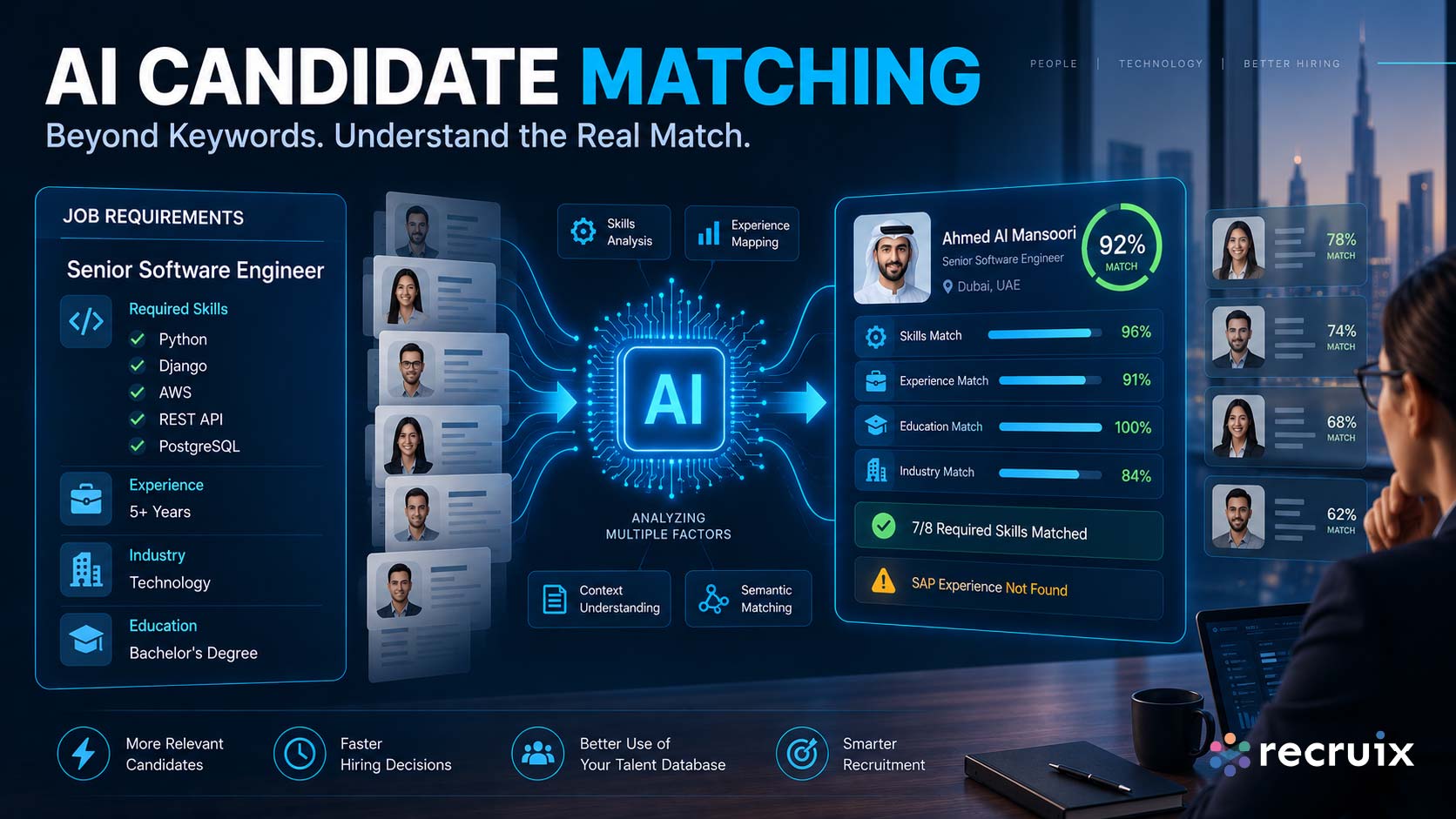
A candidate displaying a 92% match may look impressive.
But recruiters should be able to understand why that candidate received the score.
For example, a useful candidate matching system might explain:
- Skills Match: 95%
- Experience Alignment: 90%
- Education: 100%
- Industry Alignment: 85%
It might then highlight:
Strengths:
- 7 of 8 required skills identified
- Six years of relevant professional experience
- Previous experience in the required industry
- Required qualification identified
And potential gaps:
- One preferred skill was not identified
- Specific certification not found
- Salary expectation unavailable
This is significantly more useful than displaying a percentage without context.
Good AI candidate matching should help recruiters understand the recommendation, not simply ask them to trust an algorithm.
AI Candidate Matching vs AI Resume Screening
AI resume screening and AI candidate matching are related, but they solve slightly different problems.
Resume screening generally helps recruiters process incoming applications and identify which candidates warrant closer review.
Candidate matching focuses on understanding how closely a particular candidate aligns with a particular job.
Candidate matching can therefore be useful beyond newly received applications.
For example, an organization may already have thousands of candidates in its talent database.
When a new position opens, intelligent matching can potentially help recruiters rediscover existing candidates who may be suitable for the opportunity.
This can transform an existing candidate database from a passive archive into a more useful recruitment asset.
Can AI Help Recruiters Rediscover Existing Candidates?
Yes, and this is one of the potentially valuable applications of candidate matching.
Organizations frequently accumulate large candidate databases over time.
Some candidates may have applied months or years earlier. Others may have been considered for different positions.
Without effective search and matching capabilities, recruiters may begin sourcing from scratch every time a new vacancy opens.
AI-assisted matching can help surface potentially relevant candidates already available within the recruitment database.
This can help organizations make better use of talent they have already attracted.
AI Candidate Matching Inside an Applicant Tracking System
An Applicant Tracking System (ATS) provides the operational foundation for managing jobs, candidates, applications, interviews, offers, and hiring workflows.
Adding candidate intelligence to that environment allows matching information to become part of the recruiter's actual workflow.
Instead of exporting candidate data to another application, recruiters can potentially:
- Create a job
- Receive applications
- Process candidate CVs
- Review AI-assisted matches
- Compare candidates
- Move candidates through recruitment stages
- Coordinate interviews
- Manage offers and approvals
within a connected recruitment environment.
This is part of the broader evolution toward AI-powered recruitment.
What Are the Benefits of AI Candidate Matching?
Faster Candidate Discovery
Recruiters can identify potentially relevant candidates without manually comparing every profile against the job description.
Better Use of Existing Talent Databases
Candidate matching can help recruiters rediscover profiles already stored in the ATS or talent database.
More Structured Candidate Comparison
Matching candidates against defined requirements can provide recruiters with a consistent starting point for evaluation.
Greater Visibility Into Candidate Strengths and Gaps
Explainable matching can help recruiters see not only where a candidate aligns with a job, but also where important requirements may be missing.
More Time for Human Recruitment
Reducing repetitive candidate comparison gives recruiters more time for conversations, interviews, stakeholder management, and candidate engagement.
Can AI Candidate Matching Eliminate Hiring Bias?
No technology should be assumed to eliminate hiring bias automatically.
AI systems depend on their design, data, configuration, and the criteria used to evaluate candidates.
Poorly designed or inappropriate criteria can introduce or reinforce undesirable outcomes.
The NIST AI Risk Management Framework provides organizations with a framework for considering and managing risks associated with artificial intelligence.
For recruitment technology, appropriate human oversight remains particularly important.
Recruiters should understand what information contributes to recommendations and retain control over candidate progression and hiring decisions.
Should AI Automatically Reject Candidates?
Automated rejection requires careful consideration.
A candidate who appears weaker according to one set of criteria may have valuable experience or context that was not represented correctly in their resume.
AI is therefore often most valuable as a prioritization and decision-support mechanism rather than an unquestioned decision-maker.
A responsible workflow could identify:
Strong Match → Prioritize for recruiter review
Potential Match → Review additional information
Low Match → Recruiter review or configured workflow
The final recruitment decision remains with people.
What Should Recruiters Look for in AI Candidate Matching Software?
When evaluating candidate matching technology, recruitment teams should ask more than whether the platform offers an “AI match score.”
Consider whether the platform can:
- Explain why candidates received particular recommendations
- Show strengths and missing requirements
- Evaluate multiple job-related attributes
- Search existing candidate databases
- Integrate matching directly into recruitment workflows
- Allow recruiters to review and override recommendations
- Maintain appropriate auditability
- Protect candidate information
How Recruix Approaches AI Candidate Matching
Recruix combines candidate management, applicant tracking, recruitment workflows, and AI-assisted candidate matching within one recruitment platform.
The goal is to help recruiters move beyond manually searching through large candidate databases or relying solely on keyword matches.
By bringing candidate information and job requirements together, Recruix helps recruitment teams identify relevant talent and prioritize where recruiter attention should be focused.
Candidate intelligence then sits alongside the wider hiring process—from applications and interviews to approvals, offers, and onboarding.
AI helps identify the match. Recruiters make the decision.
The Future of Candidate Matching
The future of recruitment is unlikely to be defined by systems that simply store more resumes.
The real value will come from helping recruitment teams understand the talent already available to them.
As AI recruitment technology develops, candidate matching is likely to become increasingly contextual, explainable, and integrated into the wider hiring lifecycle.
The objective should not be to remove human judgment.
It should be to give recruiters better information before they exercise that judgment.
Frequently Asked Questions About AI Candidate Matching
What is AI candidate matching?
AI candidate matching uses artificial intelligence to compare candidate information with job requirements and help recruiters understand how closely a candidate may align with a particular position.
How does AI match candidates to jobs?
AI matching can analyze attributes such as skills, experience, qualifications, career history, industry background, and job requirements to identify areas of alignment and potential gaps.
Is AI candidate matching the same as keyword matching?
No. Keyword matching primarily looks for specific terms, while more advanced candidate matching can consider broader information and context surrounding the candidate and the job.
What does an AI candidate match score mean?
A match score generally represents the system's assessment of alignment between candidate information and job requirements. Recruiters should understand which criteria contribute to the score rather than treating the percentage as a final hiring decision.
Can AI find candidates already in an ATS?
Depending on the platform, candidate matching can help identify relevant profiles already stored in an organization's candidate database when new jobs become available.
Can AI decide which candidate should be hired?
AI can provide recommendations and decision support, but hiring decisions should retain appropriate human oversight and consider information beyond automated matching results.
Does AI candidate matching replace recruiters?
No. Candidate matching can reduce repetitive searching and comparison work, while recruiters remain responsible for interviews, contextual evaluation, candidate relationships, stakeholder management, and hiring decisions.
Ready to Find Relevant Candidates Faster?
Discover how Recruix can help your recruitment team use AI-assisted candidate matching to identify relevant talent, reduce manual searching, and manage the complete hiring journey through one connected recruitment platform.
The Recruix team shares practical guidance for smarter, more effective hiring.
Stay Ahead of the Future of Hiring
Get recruitment insights, AI hiring trends, and workforce intelligence delivered directly to your inbox.
Ready to Transform Your Hiring Process?
See how Recruix helps organizations hire smarter through AI-powered recruitment intelligence.
Book Demo