AI in Recruitment: How Artificial Intelligence Is Transforming the Hiring Process
Discover how AI is transforming recruitment through intelligent candidate matching, resume screening, automation, and data-driven hiring decisions—and what it means for modern recruitment teams.
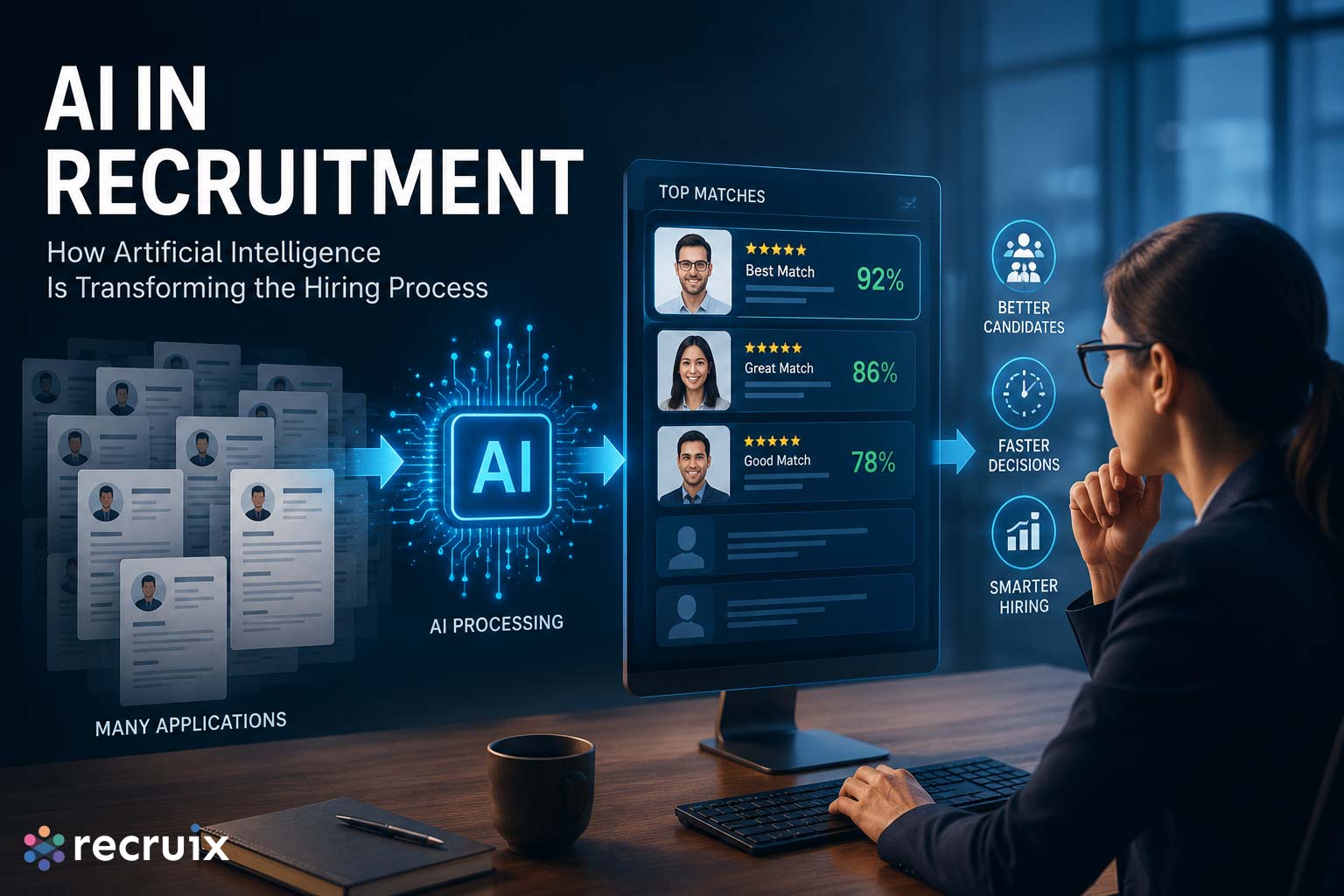
AI in Recruitment: How Artificial Intelligence Is Transforming the Hiring Process
Recruitment has always involved an enormous amount of information. A single vacancy can attract hundreds of applications, leaving recruiters to review resumes, identify relevant experience, coordinate with hiring managers, schedule interviews, manage approvals, and keep candidates informed throughout the process.
Artificial intelligence is changing how recruitment teams handle this workload.
Instead of simply digitizing manual processes, modern AI recruitment technology can help teams analyze candidate information, identify relevant talent, prioritize applications, automate repetitive activities, and make faster, more informed hiring decisions.
But what exactly does AI in recruitment mean, how does it work, and where can it deliver meaningful value?
What Is AI in Recruitment?
AI in recruitment refers to the use of artificial intelligence technologies to assist, automate, or improve different stages of the hiring process.
Depending on the system, AI can be used for tasks such as:
- Resume and CV screening
- Candidate matching and ranking
- Candidate search and discovery
- Recruitment workflow automation
- Candidate communication
- Recruitment analytics
- Hiring recommendations and decision support
The objective is not simply to replace manual activities with automation. Effective AI recruitment technology should help recruiters spend less time processing information and more time on activities where human judgment matters—speaking with candidates, understanding hiring requirements, interviewing, evaluating suitability, and building relationships.
Why Is AI Becoming Important in Recruitment?
Recruitment teams increasingly operate in an environment where both the volume and speed of hiring have changed.
Jobs can attract applications from multiple channels within hours. Recruiters may simultaneously manage numerous vacancies, while hiring managers expect qualified candidates quickly. Strong candidates may also be interviewing with several employers at the same time.
This creates a fundamental challenge:
Recruitment teams have more candidate data to process, but the best hiring decisions often need to be made faster.
AI can help address this problem by processing information at a scale that would be difficult to achieve manually.
How Is AI Used in Recruitment?
1. AI Resume Screening
Traditional resume screening requires recruiters to open applications individually and determine whether each candidate appears relevant to the position.
When hundreds of applications are received, this can consume a significant portion of a recruiter's working day.
AI-assisted resume screening can analyze candidate information such as skills, experience, education, employment history, and other job-related attributes to help recruiters identify potentially relevant applicants more efficiently.
Instead of replacing the recruiter's decision, the technology can help organize and prioritize the applications that deserve attention first.
2. AI Candidate Matching
Keyword searching has traditionally been one of the simplest ways recruitment systems identify candidates. However, keywords alone can provide an incomplete picture of suitability.
Modern AI candidate matching can consider multiple aspects of a candidate profile and compare them with the requirements of a position.
For example, matching may consider:
- Relevant skills
- Professional experience
- Role history
- Education and qualifications
- Industry experience
- Job requirements
- Other role-specific criteria
The result can help recruiters understand which candidates appear more closely aligned with a vacancy without manually comparing every profile.
3. Candidate Ranking and Prioritization
AI can also help recruitment teams prioritize large applicant pools.
Rather than presenting hundreds of candidates as an undifferentiated list, an AI-enabled recruitment platform can help surface candidates whose profiles appear more relevant to the role.
This allows recruiters to begin reviewing potentially strong candidates sooner.
Importantly, candidate ranking should support—not replace—human hiring decisions. Recruiters and hiring managers should remain responsible for evaluating candidates and determining who progresses through the recruitment process.
4. Recruitment Workflow Automation
A significant amount of recruitment work happens outside resume screening.
Recruiters coordinate interviews, communicate with candidates, request approvals, follow up with hiring managers, generate documents, manage offers, and update candidate stages.
Automation can reduce the administrative burden associated with these repetitive processes.
When AI capabilities are combined with an Applicant Tracking System (ATS), recruitment teams can potentially manage candidate intelligence and operational workflows within the same environment.
5. Recruitment Analytics and Decision Support
Recruitment platforms collect information throughout the hiring lifecycle.
This information can help organizations understand metrics such as:
- Time-to-hire
- Candidate pipeline movement
- Recruiter activity
- Hiring sources
- Interview progression
- Offer activity
AI and analytics can help transform this information into insights that recruitment leaders can use to identify bottlenecks and improve hiring processes.
What Are the Benefits of AI in Recruitment?
Faster Candidate Screening
AI can help recruitment teams process large applicant pools more efficiently, allowing recruiters to identify relevant candidates sooner.
Reduced Manual Work
Automating repetitive recruitment activities can give recruiters more time for candidate engagement, interviews, stakeholder communication, and strategic hiring activities.
More Consistent Candidate Evaluation
Structured matching criteria can help teams evaluate candidates against defined job requirements more consistently than relying entirely on unstructured manual review.
Faster Hiring Decisions
When relevant candidate information is easier to identify and hiring workflows are connected, recruiters and hiring managers can potentially move candidates through the process more efficiently.
Better Recruitment Visibility
Centralized recruitment data and analytics can give HR leaders greater visibility into hiring pipelines, recruiter activity, and recruitment performance.
Does AI Replace Recruiters?
No. The strongest use of AI in recruitment is not replacing recruiters—it is augmenting them.
Recruitment involves many decisions that require human understanding, communication, context, empathy, negotiation, and judgment.
AI is particularly useful for processing information and supporting repetitive or data-intensive activities. Recruiters remain essential for understanding organizational requirements, evaluating candidates, conducting interviews, building relationships, managing stakeholders, and making informed hiring decisions.
A more useful way to think about AI recruitment is:
AI handles more of the processing so recruiters can focus more of their time on people.
What Are the Risks of Using AI in Recruitment?
AI recruitment technology also needs to be implemented responsibly.
Organizations should consider issues including:
- Candidate data privacy
- Security and access controls
- Potential algorithmic bias
- Transparency
- Human oversight
- Data quality
- Compliance requirements
AI-generated recommendations should not automatically become final hiring decisions. Organizations should maintain appropriate human oversight and regularly review how recruitment technology is being used.
AI Recruitment vs Traditional ATS: What's the Difference?
A traditional Applicant Tracking System primarily helps organizations manage jobs, candidates, applications, recruitment stages, and related workflows.
An AI-enabled recruitment platform adds an intelligence layer to these processes.
Instead of only storing candidate information, it may help interpret that information. Instead of only displaying applicants, it may help identify potentially relevant candidates. Instead of relying entirely on recruiters to manually process every application, AI can assist with screening and prioritization.
The distinction is therefore not necessarily ATS versus AI.
Increasingly, the more relevant question is:
How intelligently can an ATS help recruitment teams manage the hiring lifecycle?
What Should Companies Look for in AI Recruitment Software?
Organizations evaluating AI recruitment software should look beyond whether a vendor simply advertises an "AI" feature.
Consider whether the platform can:
- Explain how candidate matching works
- Integrate AI into real recruitment workflows
- Keep recruiters in control of hiring decisions
- Support configurable recruitment processes
- Handle candidate and applicant data securely
- Scale across teams, departments, and hiring volumes
- Provide useful recruitment analytics
- Support the wider hiring lifecycle rather than a single isolated task
The value of AI should ultimately be measured by whether it makes recruitment teams more effective—not by how frequently the word "AI" appears in the product.
How Recruix Brings AI Into the Recruitment Process
Recruix combines applicant tracking, recruitment workflows, candidate management, and AI-assisted capabilities within a unified recruitment platform.
Rather than treating AI as a standalone feature, Recruix is designed to use technology throughout the recruitment process to help teams manage applications, identify relevant candidates, coordinate hiring activities, and move from application to hire more efficiently.
The objective is simple:
Less manual work. Faster decisions. Better hiring.
The Future of AI in Recruitment
AI in recruitment is likely to move beyond individual automation features toward increasingly connected hiring intelligence.
Recruitment platforms will be expected not only to store information but also to help teams understand it, act on it, and coordinate hiring activities more effectively.
At the same time, human judgment will remain central to successful recruitment.
The organizations that benefit most from AI are unlikely to be those that attempt to remove people from recruitment. They will be the organizations that use AI to give their recruiters better information, reduce administrative work, and create more time for meaningful human interaction.
Frequently Asked Questions About AI in Recruitment
What is AI recruitment?
AI recruitment is the use of artificial intelligence to assist with activities such as resume screening, candidate matching, applicant prioritization, recruitment automation, and hiring analytics.
How does AI help recruiters?
AI can help recruiters process candidate information more efficiently, identify potentially relevant candidates, automate repetitive activities, and prioritize where human attention is needed.
Can AI screen resumes?
Yes. AI-enabled recruitment systems can analyze information contained in resumes and help recruiters identify candidates whose profiles align with job requirements.
Can AI choose who gets hired?
AI can support candidate evaluation and prioritization, but final hiring decisions should remain subject to appropriate human review and organizational hiring processes.
What is AI candidate matching?
AI candidate matching analyzes candidate information against job requirements to help determine how closely a candidate's profile aligns with a particular role.
Will AI replace recruiters?
AI is more likely to change how recruiters work than eliminate the need for recruiters. Human judgment, communication, relationship building, interviewing, and stakeholder management remain fundamental parts of recruitment.
What is the difference between an ATS and AI recruitment software?
An ATS primarily manages candidate applications and recruitment workflows. AI recruitment capabilities can add intelligent screening, matching, prioritization, automation, and decision support to those processes.
Ready to Explore a Smarter Way to Hire?
See how Recruix can help your recruitment team reduce manual work, identify relevant candidates faster, and manage the hiring journey through one connected platform.
The Recruix team shares practical guidance for smarter, more effective hiring.
Stay Ahead of the Future of Hiring
Get recruitment insights, AI hiring trends, and workforce intelligence delivered directly to your inbox.
Ready to Transform Your Hiring Process?
See how Recruix helps organizations hire smarter through AI-powered recruitment intelligence.
Book Demo