ATS for Recruitment Agencies: What to Look for in 2026
Discover what recruitment agencies should look for in an ATS in 2026, from candidate management and AI matching to automation, recruiter productivity, reporting, integrations, and scalable workflows.
ATS for Recruitment Agencies: What to Look for in 2026
Recruitment agencies operate differently from internal corporate recruitment teams.
Recruiters may manage multiple clients, dozens of open positions, large candidate databases, high application volumes, interviews, submissions, offers, and placements—all at the same time.
That means choosing an ATS for a recruitment agency should involve more than asking whether the software can store candidates and move applicants through a pipeline.
The right recruitment platform should help recruiters work faster, rediscover existing talent, reduce repetitive administration, maintain visibility across jobs and candidates, and ultimately spend more time speaking with clients and candidates.
This guide explains what recruitment agencies should look for when evaluating an applicant tracking system in 2026.
What Is an ATS for Recruitment Agencies?
An Applicant Tracking System (ATS) is software used to manage jobs, candidates, applications, interviews, hiring stages, communication, offers, and other recruitment activities.
If you are new to the category, our complete guide explains what an Applicant Tracking System is and how it works.
For recruitment agencies, however, an ATS often needs to support a more candidate-intensive and fast-moving operating model.
An agency recruiter may work on several vacancies across different clients while simultaneously searching an existing candidate database and processing new applications.
The system therefore needs to do more than record recruitment activity.
It needs to help recruiters turn candidate information into placements efficiently.
Why Recruitment Agencies Need More Than a Basic ATS
A basic ATS may provide jobs, candidate records, application stages, notes, and interview scheduling.
Those capabilities are important, but they do not necessarily solve the biggest productivity challenges inside a recruitment agency.
Consider what happens when an agency has:
- Thousands of historical candidate profiles
- Hundreds of incoming CVs
- Multiple recruiters working simultaneously
- Several active jobs per recruiter
- Different client requirements
- Candidates suitable for multiple positions
- Urgent vacancies competing for recruiter attention
The challenge quickly becomes one of information, speed, coordination, and prioritization.
A modern recruitment platform should help solve those problems rather than simply digitize them.
1. Strong Candidate Database Management
For a recruitment agency, the candidate database can become one of its most valuable assets.
Over time, agencies accumulate candidates from job applications, referrals, sourcing, previous placements, imported databases, and recruiter outreach.
But a large database has limited value if recruiters cannot find the right people when a new vacancy arrives.
An effective agency ATS should make it easy to:
- Search candidate profiles
- Filter candidates using relevant criteria
- View complete candidate histories
- Understand previous applications
- Maintain updated candidate information
- Add candidates to appropriate jobs
- Identify duplicate candidate records
- Rediscover candidates for new opportunities
The objective should be to transform the candidate database from an archive into an active recruitment resource.
2. Fast CV Parsing and Bulk Candidate Processing
Recruitment agencies frequently deal with high volumes of CVs.
Manually creating candidate profiles from every resume can consume significant recruiter time.
CV parsing technology can extract information such as:
- Candidate contact details
- Skills
- Employment history
- Education
- Qualifications
- Job titles
- Experience
Bulk processing becomes particularly important when agencies receive large candidate folders, migrate historical databases, or process applications for high-volume positions.
A strong system should also handle existing candidates intelligently rather than creating unnecessary duplicate profiles whenever the same candidate appears again.
3. AI Resume Screening
High application volume creates another problem: recruiters still need to determine which candidates deserve attention first.
AI resume screening can help recruitment teams analyze incoming applications and prioritize potentially relevant candidates.
Instead of manually opening every CV in the order received, recruiters can begin their review with candidates whose profiles appear more closely aligned with the position.
The goal is not to remove recruiter judgment.
It is to make better use of recruiter time.
4. AI Candidate Matching and Talent Rediscovery
One of the biggest opportunities for recruitment agencies is often hidden inside their existing candidate database.
When a new vacancy arrives, recruiters should not necessarily need to start sourcing from zero.
AI candidate matching can help compare job requirements with candidate information and surface potentially relevant profiles.
Effective matching can consider factors such as:
- Skills
- Relevant experience
- Previous roles
- Qualifications
- Industry background
- Seniority
- Job-specific requirements
More importantly, recruiters should be able to understand why a candidate appears relevant rather than simply being shown an unexplained score.
5. Flexible Recruitment Pipelines
Not every agency recruits in exactly the same way.
A permanent placement workflow may differ from executive search, high-volume recruitment, specialist recruitment, or other hiring models.
An agency ATS should therefore support configurable recruitment stages.
A typical pipeline might include:
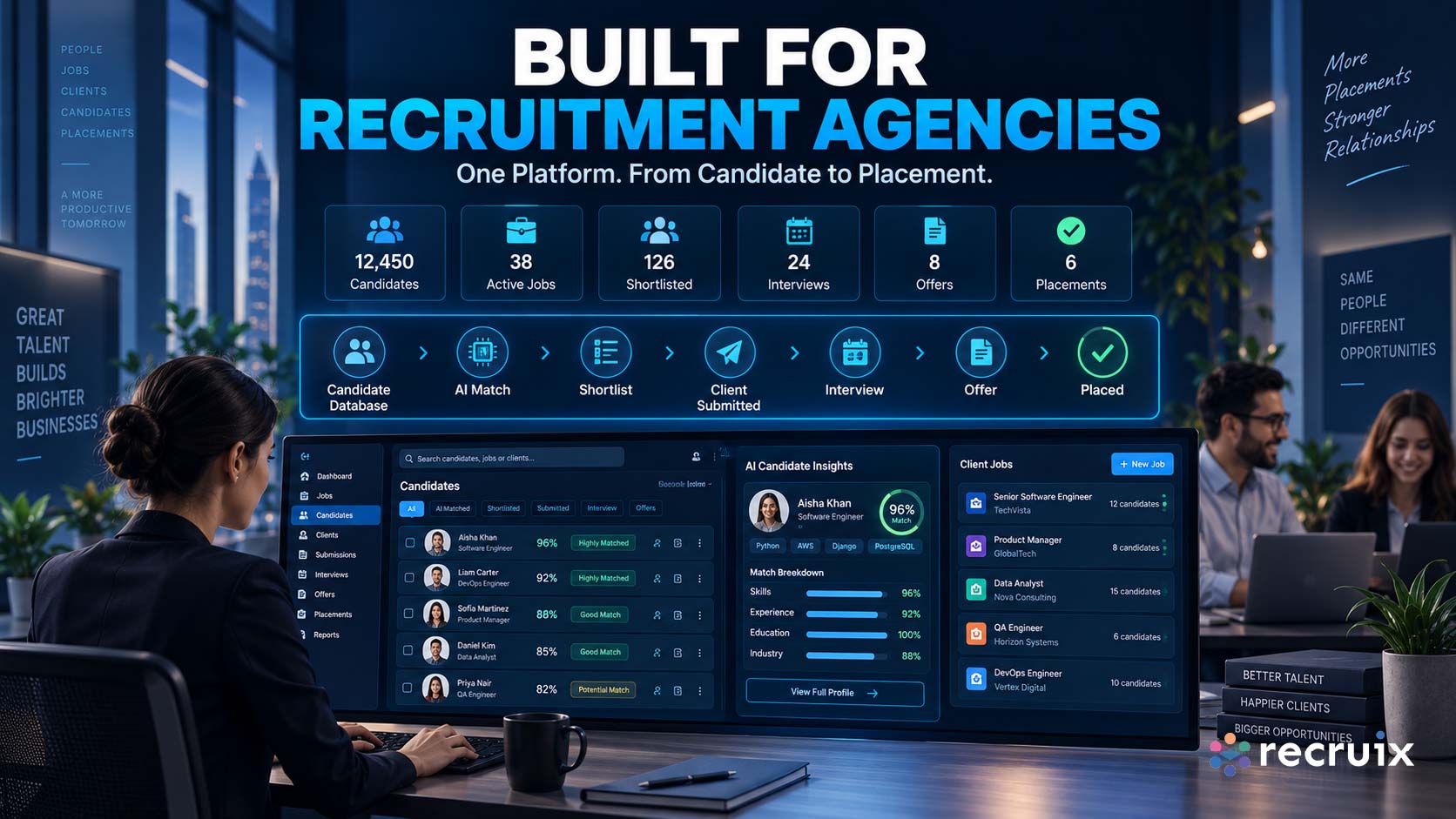
Applied → Screened → Shortlisted → Client Submitted → Client Interview → Offer → Placed
Another team may require additional stages.
The software should adapt to the recruitment process rather than forcing every recruiter into an unnecessarily rigid workflow.
6. Recruitment Automation
Recruiters perform many repetitive activities throughout the day.
These can include:
- Candidate emails
- Status notifications
- Interview communication
- Follow-ups
- Task creation
- Internal notifications
- Candidate-stage updates
Recruitment automation can reduce the amount of administrative work required to keep these processes moving.
Automation should not make recruitment feel impersonal. Used appropriately, it can give recruiters more time for the conversations that actually require human interaction.
7. Candidate-to-Job Relationships
Recruitment databases need to distinguish between a candidate and an application.
A candidate is the person's master profile.
An applicant represents that candidate's relationship with a particular job.
This distinction matters because the same candidate may be suitable for several vacancies over time.
A well-designed ATS should preserve the candidate's history while allowing recruiters to manage that person independently across different jobs.
This creates cleaner candidate data and a more complete view of the recruiter's relationship with each candidate.
8. Recruiter Collaboration and Ownership
As an agency grows, multiple recruiters may interact with the same jobs and candidates.
The ATS should make ownership and activity clear.
Teams should be able to understand:
- Who owns a candidate
- Who added or updated information
- Which recruiter is responsible for a job
- What communication has already taken place
- What actions are pending
Good visibility reduces duplicate work and helps recruiters collaborate without losing accountability.
9. Client-Ready Candidate Presentation
Recruitment agencies eventually need to present candidates to clients.
That process should be professional and efficient.
Depending on the agency's workflow, useful capabilities may include standardized candidate profiles, branded CV presentation, recruiter notes, candidate summaries, or structured submissions.
The objective is to help the agency deliver a consistent client experience without requiring recruiters to manually recreate candidate documents for every submission.
10. Interview, Offer and Placement Management
The recruitment process does not end when a candidate is shortlisted.
The ATS should help teams coordinate the stages that follow, including:
- Interviews
- Candidate communication
- Client feedback
- Offer management
- Approvals where required
- Candidate documentation
- Placement or joining activities
Keeping these activities connected gives recruiters greater visibility over where every candidate stands.
11. Recruitment Analytics
Agency leaders need to understand more than how many candidates exist in the database.
Useful recruitment analytics may include:
- Jobs by status
- Applications per job
- Candidate pipeline movement
- Recruiter activity
- Interview progression
- Offer activity
- Candidate sources
- Time-to-hire
- Placement activity
Analytics should help managers identify bottlenecks and understand where recruiter effort is producing results.
12. Job Board and Sourcing Integrations
Recruitment agencies frequently depend on multiple sourcing channels.
When evaluating an ATS, agencies should consider which job boards, professional networks, sourcing providers, and recruitment services can connect with the platform.
Integration requirements will vary by country and recruitment specialization, so agencies should evaluate the channels that matter to their actual hiring market rather than simply choosing the platform with the longest integration list.
13. Email and Communication Integration
Candidate communication should ideally remain connected to the recruitment record.
Integration with commonly used business email platforms can help recruiters communicate without losing visibility of candidate interactions.
This becomes increasingly important as recruitment teams grow and several people may interact with the same candidate.
14. Permissions and Data Security
Recruitment agencies manage significant amounts of personal candidate information.
Access should therefore be controlled appropriately.
An ATS should support role-based permissions and help organizations determine which users can view, edit, approve, export, or manage different areas of the system.
Organizations operating across jurisdictions should also evaluate privacy, security, retention, and compliance requirements relevant to their markets.
The European Commission's data protection resources provide information about EU data protection rules for organizations processing personal information in Europe.
15. Scalability Without Unnecessary Complexity
The system that works for five recruiters should not become unusable when the agency grows to fifty.
At the same time, smaller agencies should not need an enterprise implementation project just to start recruiting.
Look for a platform that can accommodate increasing users, jobs, candidate volumes, workflows, and reporting requirements while remaining manageable for recruiters.
ATS vs Recruitment CRM: Does an Agency Need Both?
The distinction between ATS and recruitment CRM functionality has become increasingly blurred.
Traditionally, an ATS focused primarily on active applications and hiring workflows, while recruitment CRM software focused on talent relationships, candidate databases, sourcing, and engagement.
For many agencies, the more useful question is not whether the product is labelled an ATS or CRM.
It is whether the platform supports the complete recruitment workflow the agency actually needs.
Questions to Ask Before Choosing an ATS for Your Recruitment Agency
Before purchasing recruitment software, ask potential vendors:
- Can we import our existing candidate database?
- How does the platform identify duplicate candidates?
- Can we bulk process CVs?
- Can recruiters rediscover existing candidates for new jobs?
- How does AI candidate matching work?
- Can the system explain AI recommendations?
- Can we customize recruitment stages?
- What activities can be automated?
- How are candidate and applicant records managed?
- Can recruiters collaborate without duplicating work?
- Which job boards and sourcing channels integrate?
- Does email integrate with the recruitment record?
- What reporting is available?
- How are permissions controlled?
- What implementation and support are provided?
- Can the system scale as our agency grows?
These questions are often more useful than comparing products based purely on the number of features listed on their websites.
How Recruix Supports Recruitment Agencies
Recruix is an AI-powered recruitment platform designed to bring candidate management, applicant tracking, recruitment workflows, AI-assisted matching, interviews, offers, onboarding, and recruitment analytics into one connected environment.
For recruitment agencies managing high candidate volumes, Recruix helps teams process candidate information, identify relevant talent, manage multiple jobs, and reduce repetitive recruitment administration.
Instead of treating AI as a separate tool, candidate intelligence becomes part of the recruitment workflow.
The objective is straightforward:
Spend less time processing recruitment data and more time placing the right people.
The Best ATS Is the One That Fits How Your Agency Recruits
There is no single recruitment platform that is automatically right for every agency.
A small specialist recruiter, a high-volume staffing business, and a multinational recruitment agency may have very different requirements.
The right decision should therefore be based on workflows, candidate volumes, sourcing strategy, integrations, reporting, security, scalability, and how recruiters actually work every day.
Technology should remove friction from recruitment—not add another layer of administration.
Frequently Asked Questions
What is the best ATS for recruitment agencies?
The best ATS depends on the agency's size, recruitment model, candidate volume, required integrations, workflows, reporting needs, and budget. Agencies should evaluate how well each platform supports their actual recruitment process rather than choosing solely by feature count.
Do recruitment agencies need an ATS?
An ATS becomes increasingly valuable as an agency manages more candidates, vacancies, recruiters, and client processes. It provides a centralized system for candidate records, applications, workflows, communication, interviews, offers, and reporting.
What is the difference between an ATS and recruitment CRM?
An ATS traditionally focuses on active hiring workflows, while recruitment CRM software focuses more heavily on talent relationships and candidate engagement. Modern recruitment platforms increasingly combine elements of both.
Can an ATS help find candidates already in the database?
Yes. Search and AI-assisted candidate matching can help recruiters identify potentially relevant candidates already stored in the recruitment database when new vacancies become available.
Can recruitment agencies use AI to screen CVs?
Yes. AI-assisted resume screening can help recruitment agencies process large applicant volumes and prioritize potentially relevant candidates for recruiter review.
Should recruitment agencies choose an ATS based on the number of integrations?
Not necessarily. Agencies should first identify the job boards, communication platforms, sourcing channels, and business systems they actually use and then evaluate whether the ATS supports those requirements.
Looking for an AI-Powered ATS for Your Recruitment Agency?
Discover how Recruix can help your recruitment team manage candidates, identify relevant talent faster, streamline recruitment workflows, and scale your agency through one connected platform.
The Recruix team shares practical guidance for smarter, more effective hiring.
Stay Ahead of the Future of Hiring
Get recruitment insights, AI hiring trends, and workforce intelligence delivered directly to your inbox.
Ready to Transform Your Hiring Process?
See how Recruix helps organizations hire smarter through AI-powered recruitment intelligence.
Book Demo