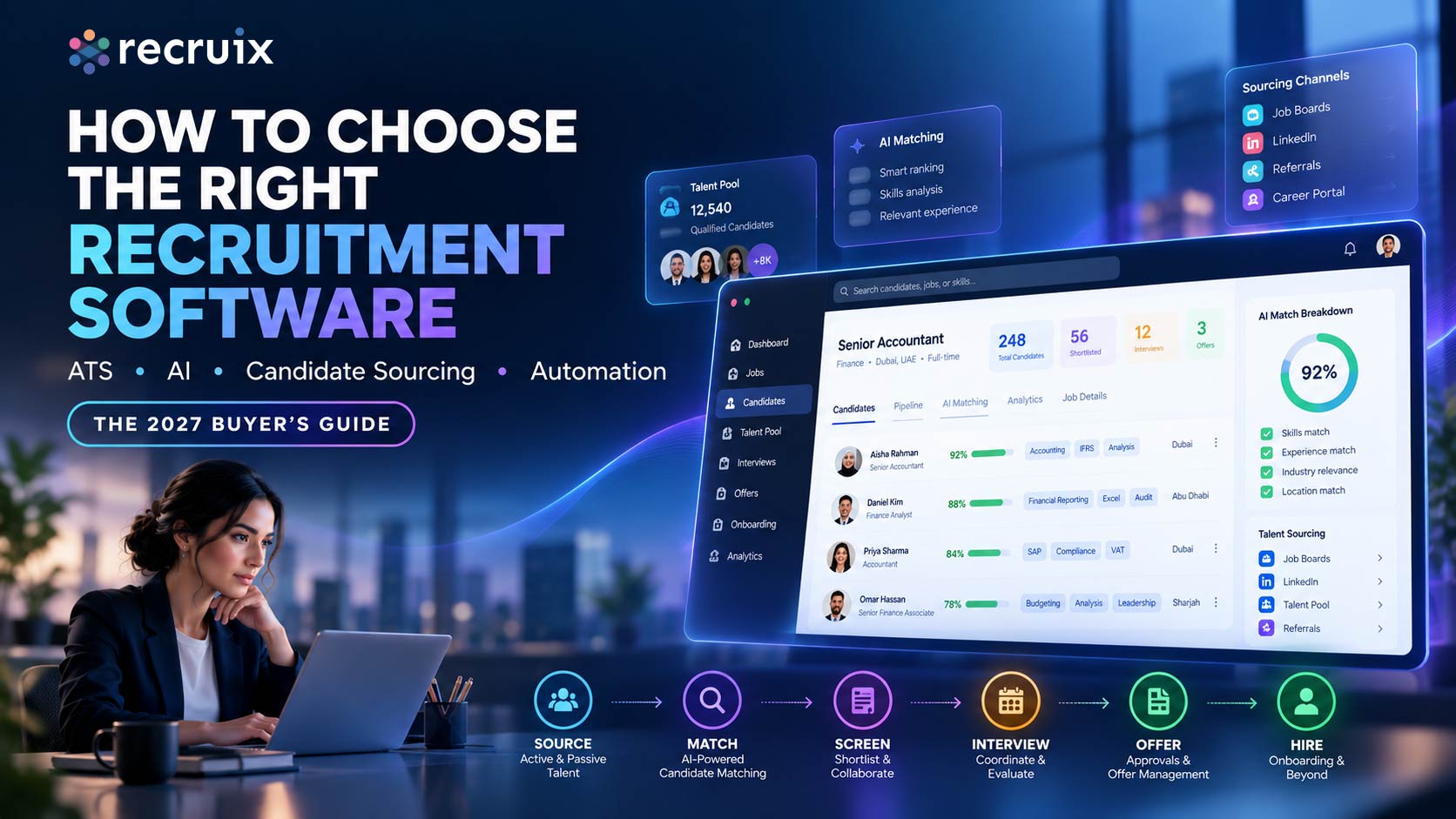
Choosing recruitment software used to be relatively straightforward: companies needed a system to store applications, move candidates through hiring stages and keep recruitment records organised.
As organisations plan their hiring strategies for 2027, that is no longer enough.
Recruitment teams increasingly need to source talent, manage large candidate databases, rediscover previous applicants, screen CVs, match candidates to jobs, automate repetitive work, collaborate with hiring managers, manage approvals, coordinate interviews and offers, provide a better candidate experience and understand recruitment performance.
This means the question is no longer simply:
“Which applicant tracking system should we buy?”
A better question is:
“What recruitment capabilities does our organisation actually need, and which platform can support the way we want to hire?”
This 2027 buyer's guide explains what to evaluate when choosing an ATS or recruitment platform, including candidate sourcing, AI-assisted recruitment, workflow automation, integrations, candidate experience, analytics and enterprise requirements.
What Is Recruitment Software?
Recruitment software is technology used to help organisations manage some or all of the hiring process, from creating a vacancy and attracting candidates through screening, interviews, offers and hiring.
Depending on the platform, recruitment software may include:
- Job requisition management
- Applicant tracking
- Candidate sourcing
- Candidate databases and talent pools
- CV parsing
- AI-assisted candidate matching
- Candidate ranking and screening
- Recruitment workflows
- Hiring-manager collaboration
- Interview scheduling
- Email and candidate communication
- Offer management
- Onboarding workflows
- Career portals
- Recruitment analytics
- Integrations with HRMS and HCM platforms
The exact capabilities vary significantly between products. That is why organisations should evaluate recruitment software based on their hiring process rather than simply comparing the number of features advertised by different vendors.
ATS vs Recruitment Software: What Is the Difference?
An Applicant Tracking System (ATS) traditionally focuses on managing candidates after they enter the recruitment process. It helps recruiters organise applications, track candidate stages and maintain recruitment records.
Modern recruitment platforms can extend beyond applicant tracking.
They may help organisations source candidates, search existing talent databases, use AI to assist screening and matching, automate recruitment workflows, manage complex approvals, operate branded career portals and analyse hiring performance.
However, the terminology is not always consistent. Many modern ATS products now include broader recruitment capabilities, while some products described as recruitment platforms may still provide relatively basic applicant tracking.
Therefore, buyers should evaluate actual capabilities and workflows rather than relying on the product category alone.
Do You Need an ATS or a Complete Recruitment Platform?
The answer depends on how your organisation hires.
Small businesses with occasional hiring
A straightforward ATS may be sufficient if the organisation hires relatively few employees and has simple approval and recruitment processes.
The priorities may simply be job posting, application management, interview coordination and candidate communication.
Growing companies
As hiring volume increases, organisations usually need more structure.
This can include recruitment workflows, candidate databases, automation, hiring-manager collaboration, reporting, career portals and integrations with other business systems.
Recruitment agencies
Agencies often require more than traditional applicant tracking.
They may need candidate sourcing, searchable talent databases, candidate rediscovery, recruiter productivity tools, client and vacancy management, communication automation and high-volume candidate processing.
Our guide to ATS for recruitment agencies explains these requirements in more detail.
Enterprise organisations
Large organisations may need organisational hierarchy, multi-level requisition approvals, offer approval matrices, business-unit-specific workflows, advanced permissions, audit trails, integrations, security controls, analytics and the ability to support multiple recruiters and hiring managers across different entities or locations.
For enterprise buyers, workflow flexibility and governance can be just as important as applicant tracking itself.
Candidate Sourcing: Where Will Your Next Hire Come From?
One of the most important questions when evaluating recruitment technology is:
Does the system only manage people who apply, or does it also help recruiters find people who may be suitable?
Candidate sourcing is the process of identifying potential candidates for open positions and proactively reaching them.
Indeed's employer guidance identifies candidate databases, employee referrals, social media, hiring events, job postings and internal talent among the approaches organisations can use to source candidates.
Source: Indeed – An Employer's Guide for Sourcing Candidates.
A modern sourcing strategy can therefore combine several channels:
- Career portals
- Job boards
- Existing candidate databases
- Previous applicants
- Employee referrals
- Recruitment agencies
- Professional networks
- Talent communities
- Career fairs and recruitment events
- Internal employees
- Direct candidate outreach
The recruitment platform should help bring these candidate sources into a manageable recruitment process rather than leaving recruiters to maintain disconnected spreadsheets, inboxes and databases.
Your Existing Candidate Database Should Be a Sourcing Channel
Many organisations spend significant time and money attracting candidates for every new vacancy while overlooking people already present in their recruitment database.
Consider an organisation that has accumulated tens of thousands of candidate profiles over several years.
When a new Senior Accountant vacancy opens, should the first action always be to advertise externally?
Not necessarily.
A better recruitment process should make it easy to ask:
“Which candidates already in our database could match this vacancy?”
Previous applicants, talent pools and existing candidate databases can become valuable sourcing channels when the information remains relevant and its use complies with applicable privacy and retention requirements.
That makes candidate rediscovery an important capability to evaluate.
A useful recruitment platform should allow recruiters to search historical candidates, identify potentially relevant profiles and reconnect with suitable people where appropriate.
AI Candidate Matching in 2027: Ask What the AI Actually Does
Artificial intelligence has become increasingly common across recruitment technology.
Simply asking a vendor, “Does your ATS have AI?” is therefore not particularly useful.
Instead, ask what the AI actually does.
Depending on the system, AI may assist with:
- CV parsing
- Candidate profile summarisation
- Job description assistance
- Candidate-to-job matching
- Candidate ranking
- Skills identification
- Talent database search
- Candidate rediscovery
- Interview preparation
- Recruitment analytics
AI can be useful for reducing repetitive work and helping recruiters navigate large candidate volumes. The OECD has documented recruitment use cases including application pre-screening, candidate support, interview planning and matching candidates to available opportunities.
Source: OECD – AI in Civil Service Reform.
But AI output should not automatically be treated as objective or correct.
The International Labour Organization has highlighted important questions around data quality, objectives, transparency and the way AI systems evaluate people in recruitment and HR.
Source: International Labour Organization – AI in Human Resource Management.
Look for Explainable AI, Not Just a Match Percentage
Suppose a recruitment system tells a recruiter:
Candidate Match: 87%
The next question should be:
Why 87%?
A useful AI-assisted recruitment experience should help the recruiter understand the factors contributing to a recommendation.
For example:
- Required skills identified
- Relevant industry experience
- Years of relevant experience
- Required qualifications or certifications
- Relevant location or market experience
- Skills or requirements that may be missing
The recruiter can then review the evidence and make an informed decision.
AI should support professional judgement rather than remove accountability from the hiring process.
Learn more about AI candidate matching beyond keyword matching and AI resume screening.
Recruiters Should Remain in Control
AI-assisted recruitment should not mean that an unexplained algorithm automatically decides who deserves employment.
Human oversight remains important, particularly where automated tools influence screening, ranking or assessment.
The ILO's research on AI in HR management highlights risks associated with poor-quality data, poorly defined objectives and opaque systems.
Organisations evaluating AI recruitment technology should therefore consider:
- Whether AI recommendations are explainable
- Whether recruiters can review underlying candidate information
- Whether recommendations can be overridden
- Whether important actions are auditable
- How candidate data is processed
- How long candidate information is retained
- Whether automated decisions are used and, if so, how they are governed
Recruitment Workflow Automation: Does the Software Match Your Process?
Recruitment is rarely a single linear process.
Different organisations—and sometimes different departments within the same organisation—can have very different hiring workflows.
A recruitment platform may need to support:
- Job requisition creation
- Multi-level requisition approvals
- Recruiter assignment
- Candidate screening
- Hiring-manager shortlisting
- Multiple interview stages
- Assessment stages
- Offer approvals
- Document collection
- Candidate acceptance
- Joining workflows
- Onboarding handover
Before purchasing software, map your existing recruitment process and identify where work currently happens outside your system.
If recruiters regularly rely on spreadsheets, personal email inboxes, manual reminders or separate approval trackers, those areas may represent opportunities for automation.
Explore recruitment automation.
Don't Choose Recruitment Software From a Feature Checklist Alone
One recruitment platform may advertise 150 features while another advertises 90.
That does not automatically make the first platform better for your organisation.
Instead of asking vendors to deliver a generic presentation, give them a realistic recruitment scenario.
We receive 600 CVs for a vacancy. Three recruiters work on the role. The hiring manager reviews the shortlist. The requisition requires two approvals. The final offer requires four approvals depending on department. Selected candidates must upload documents. HR needs to approve those documents. The candidate then accepts the offer, and selected information eventually needs to move into our HCM or HRMS.
Then ask:
“Show us how your system handles this process from beginning to end.”
This reveals much more than comparing feature lists.
Evaluate the Recruiter's Day-to-Day Experience
Recruiters may spend hours every day inside recruitment software.
Usability therefore matters.
During a product demonstration, ask an actual recruiter to perform common tasks:
- Create a vacancy
- Upload or import candidates
- Find a previous candidate
- Review candidate information
- Compare candidates
- Move candidates through stages
- Send communication
- Schedule an interview
- Request hiring-manager feedback
- Prepare an offer
- Find recruitment reports
Count the steps required and observe whether the workflow feels intuitive.
A powerful system that recruiters struggle to use can create new operational problems rather than solving existing ones.
Candidate Experience Matters Too
Recruitment software affects candidates as well as recruiters.
Evaluate the candidate journey from the perspective of someone applying for a job.
Ask:
- Is the career portal mobile-friendly?
- Is account creation straightforward?
- Can candidates upload a CV easily?
- Does the application request unnecessary information?
- Can candidates maintain their profile?
- Can they understand the status of their applications?
- Can interview information be communicated clearly?
- Can documents be uploaded securely?
- Can offers be reviewed and accepted digitally?
- Does the experience reflect the employer's brand?
A recruitment system should make hiring more efficient without creating unnecessary friction for candidates.
Explore how a modern career portal can support the candidate journey.
What About Skills-Based Hiring?
Skills are becoming increasingly important in workforce planning and candidate matching.
In the UAE, the UAE Skills Platform connects education, skills, careers and labour-market information and provides information about job demand and skills trends.
Source: UAE Skills Platform – MoHRE & MoHESR.
For recruitment teams, this reinforces an important principle: candidate evaluation should not rely exclusively on job titles or simple keyword matching.
Recruitment systems should help organisations understand relevant skills, experience and job requirements while allowing recruiters and hiring managers to apply professional judgement.
Integrations: Recruitment Software Should Not Become Another Data Silo
Recruitment rarely operates in isolation.
Depending on the organisation, recruitment software may need to connect with:
- HRMS or HCM platforms
- Email systems
- Microsoft 365
- Calendar systems
- Video interviewing platforms
- Job boards
- Assessment providers
- Background verification services
- Payroll or employee systems
- Business intelligence tools
- APIs and webhooks
Enterprise buyers should understand not only whether an integration exists, but also what information moves between systems, how frequently it synchronises, which platform remains the system of record and how failures are handled.
Recruitment Analytics: Measure More Than Applications
A modern recruitment platform should help teams understand what is happening throughout the hiring funnel.
Useful recruitment analytics may include:
- Open requisitions
- Applications by source
- Candidate pipeline distribution
- Stage conversion rates
- Time spent in recruitment stages
- Interview activity
- Offer activity
- Recruiter workload
- Source effectiveness
- Hiring-manager activity
- Talent-pool utilisation
The objective is not simply to produce more dashboards.
Recruitment analytics should help teams identify bottlenecks and make better operational decisions.
Use Labour-Market Intelligence Alongside Recruitment Data
Internal recruitment analytics tell organisations what is happening inside their hiring process. External labour-market information can provide additional context about workforce trends and skills.
The UAE Labour Market Observatory provides government-led labour-market information, including workforce trends, reports and interactive dashboards.
For organisations recruiting in the UAE, resources such as this can complement internal recruitment analytics when considering workforce planning and talent strategy.
Security, Permissions and Auditability
Recruitment platforms contain substantial amounts of personal candidate information.
Security should therefore be part of the procurement process from the beginning.
Depending on the organisation and jurisdictions involved, buyers may need to evaluate:
- Role-based permissions
- Authentication controls
- Audit trails
- Data encryption
- Data retention
- Candidate consent and privacy workflows
- Deletion processes
- Backup and recovery
- Vendor security practices
- Relevant certifications and regulatory requirements
Enterprise buyers should involve appropriate security, privacy, legal and IT stakeholders rather than treating recruitment software as an HR-only purchase.
Basic ATS vs Modern Recruitment Platform vs Enterprise Recruitment Platform
| Capability | Basic ATS | Modern Recruitment Platform | Enterprise Recruitment Platform |
|---|---|---|---|
| Applicant tracking | Yes | Yes | Yes |
| CV parsing | Varies | Common | Common |
| Candidate sourcing | Limited/varies | Often available | Usually important |
| Talent rediscovery | Limited | Often available | Important |
| AI-assisted matching | Varies | Increasingly common | Increasingly common |
| Workflow automation | Basic | Moderate/advanced | Advanced |
| Complex approvals | Limited | Varies | Important |
| Career portal | Basic/varies | Common | Common |
| Offer workflows | Varies | Common | Advanced requirements |
| Analytics | Basic | Moderate | Advanced |
| Integrations | Limited | Important | Critical |
| Permissions and auditability | Basic | Moderate | Advanced |
| Multi-entity complexity | Limited | Varies | Often required |
These categories are illustrative rather than universal. Individual products can provide capabilities above or below the typical level shown.
15 Questions to Ask Before Choosing Recruitment Software in 2027
- Does the platform only manage applicants, or can it also support candidate sourcing?
- Can recruiters search and rediscover candidates already in our database?
- How does CV parsing work, and what information does it extract?
- Can the platform match candidates against job requirements?
- If AI ranks candidates, can recruiters understand why?
- Can recruiters review and override AI-assisted recommendations?
- Can recruitment workflows reflect the way our organisation actually hires?
- Can different departments, entities or job types use different approval processes?
- How easily can hiring managers participate?
- Can the system manage interviews, offers, documents and onboarding workflows?
- Can the career portal reflect our employer brand?
- Can the platform integrate with our HRMS, HCM, email and other systems?
- Does it provide actionable recruitment analytics?
- Are security, permissions, privacy controls and audit trails appropriate for our organisation?
- Can the platform adapt as our recruitment process changes?
A Practical Recruitment Software Evaluation Exercise
Before signing a contract, select three real vacancies from your organisation:
- One high-volume vacancy
- One specialist or difficult-to-fill vacancy
- One vacancy with a complex approval process
Ask each shortlisted vendor to demonstrate how its platform would manage those scenarios.
Where possible, involve recruiters, hiring managers, HR leadership and IT or security stakeholders.
Score the platforms against the same criteria, such as:
- Recruiter usability
- Candidate sourcing
- Candidate search and rediscovery
- AI usefulness and explainability
- Workflow flexibility
- Hiring-manager experience
- Candidate experience
- Integrations
- Analytics
- Security and governance
- Implementation effort
- Vendor support
- Ability to support future recruitment requirements
This produces a much more meaningful comparison than selecting software based on the longest feature list.
Choosing Recruitment Software in the UAE for 2027
Organisations recruiting in the UAE may have additional considerations including multinational workforces, rapid hiring, multiple business entities, workforce planning, Emiratisation strategies and integration with broader HR systems.
The UAE Labour Market Observatory provides labour-market information and workforce insights that organisations can use alongside their own recruitment data when considering workforce planning and talent strategy.
Explore the UAE Labour Market Observatory for current official labour-market information.
For organisations specifically evaluating technology for the UAE market, see our detailed guide to recruitment software in the UAE.
Where Recruix Fits
Recruix is an AI-powered recruitment platform and applicant tracking system designed to help organisations manage candidates, automate recruitment workflows, match talent to jobs and manage hiring processes from requisition through onboarding.
Recruix brings together capabilities including candidate management, AI-assisted matching, resume parsing, recruitment workflows, approvals, career portals, interview processes, offers, onboarding workflows and recruitment analytics.
The objective is not to remove recruiters from hiring decisions. It is to reduce repetitive recruitment work, make candidate information easier to use and give recruitment teams better tools for managing increasingly complex hiring operations.
Explore AI Hiring Intelligence, Candidate Management and Recruitment Automation to learn more.
Recruitment Software Evaluation Checklist for 2027
Before your next vendor demonstration, copy this checklist:
- Applicant tracking
- Candidate sourcing
- Candidate database search
- Talent rediscovery
- CV parsing
- AI candidate matching
- Explainable recommendations
- Human review and override
- Recruitment workflow automation
- Requisition approvals
- Hiring-manager collaboration
- Interview management
- Offer approvals
- Document management
- Onboarding workflow
- Career portal
- Candidate experience
- Recruitment analytics
- HRMS/HCM integrations
- Email/calendar integrations
- Job-board integrations
- APIs/webhooks
- Role-based permissions
- Audit trails
- Privacy/data retention
- Security
- Implementation requirements
- Vendor support
- Scalability
- Future product roadmap
Frequently Asked Questions
What is the best recruitment software for 2027?
There is no single recruitment platform that is best for every organisation. The right choice depends on hiring volume, sourcing requirements, recruitment workflows, company size, integrations, security requirements, candidate experience and the complexity of the organisation's hiring process.
What is an applicant tracking system?
An applicant tracking system is software used to organise and manage candidates throughout the recruitment process. Modern ATS platforms may also include sourcing, AI-assisted screening, workflow automation, career portals, offers, analytics and integrations.
What is candidate sourcing?
Candidate sourcing is the process of identifying potential candidates for vacancies, often before or in addition to receiving direct applications. Sources can include candidate databases, job boards, referrals, professional networks, recruitment events, internal talent and direct outreach.
Can an ATS help source candidates?
Some ATS platforms can. Capabilities vary considerably. Buyers should check whether a platform can search previous applicants, maintain talent pools, integrate with sourcing channels and help recruiters rediscover relevant candidates for new vacancies.
What should I look for in an AI recruitment platform in 2027?
Look beyond whether the vendor simply advertises AI. Evaluate what the AI actually does, what information it uses, whether recommendations are explainable, whether recruiters can review and override results, and whether AI improves a genuine recruitment workflow.
Should AI automatically reject candidates?
Organisations should approach automated employment decisions carefully. AI can support screening and prioritisation, but human oversight, explainability, data quality, fairness, privacy and applicable employment requirements should be considered when automated tools influence hiring decisions.
What is recruitment automation?
Recruitment automation uses technology to reduce repetitive work in processes such as candidate communication, workflow progression, reminders, approvals, interview coordination, document collection and other administrative recruitment tasks.
How should an enterprise evaluate an ATS?
Enterprise buyers should evaluate actual end-to-end recruitment scenarios rather than relying only on feature lists. Particular attention should be given to workflow flexibility, organisational hierarchy, approvals, integrations, security, permissions, auditability, reporting, candidate experience and implementation requirements.
Can recruitment software integrate with an existing HCM or HRMS?
Many recruitment platforms support integrations, but the scope varies. Buyers should establish which system will remain the source of truth, what data needs to move between systems, how synchronisation works and how integration errors are monitored and resolved.
Final Thoughts: Choosing Recruitment Technology for 2027
The right recruitment platform should do more than store applications.
It should help recruiters find and rediscover talent, understand candidates, collaborate with hiring managers, reduce unnecessary administration, manage recruitment workflows and make better use of recruitment data.
Before choosing a platform for 2027 and beyond, map your real recruitment process, identify the biggest areas of friction and ask every vendor to demonstrate how its system would solve those specific problems.
Don't buy the recruitment platform with the longest feature list. Choose the platform that best supports the way your organisation needs to hire.
If you are currently evaluating an ATS or recruitment platform, book a personalised Recruix demonstration and bring one of your real recruitment workflows. We can show you how it could be managed in Recruix.