Emiratisation Recruitment: How UAE Companies Can Build a Smarter Hiring Strategy in 2026
Learn how UAE companies can build a stronger Emiratisation recruitment strategy by improving Emirati talent sourcing, candidate pipelines, skills matching, recruitment workflows, analytics, and long-term workforce planning.
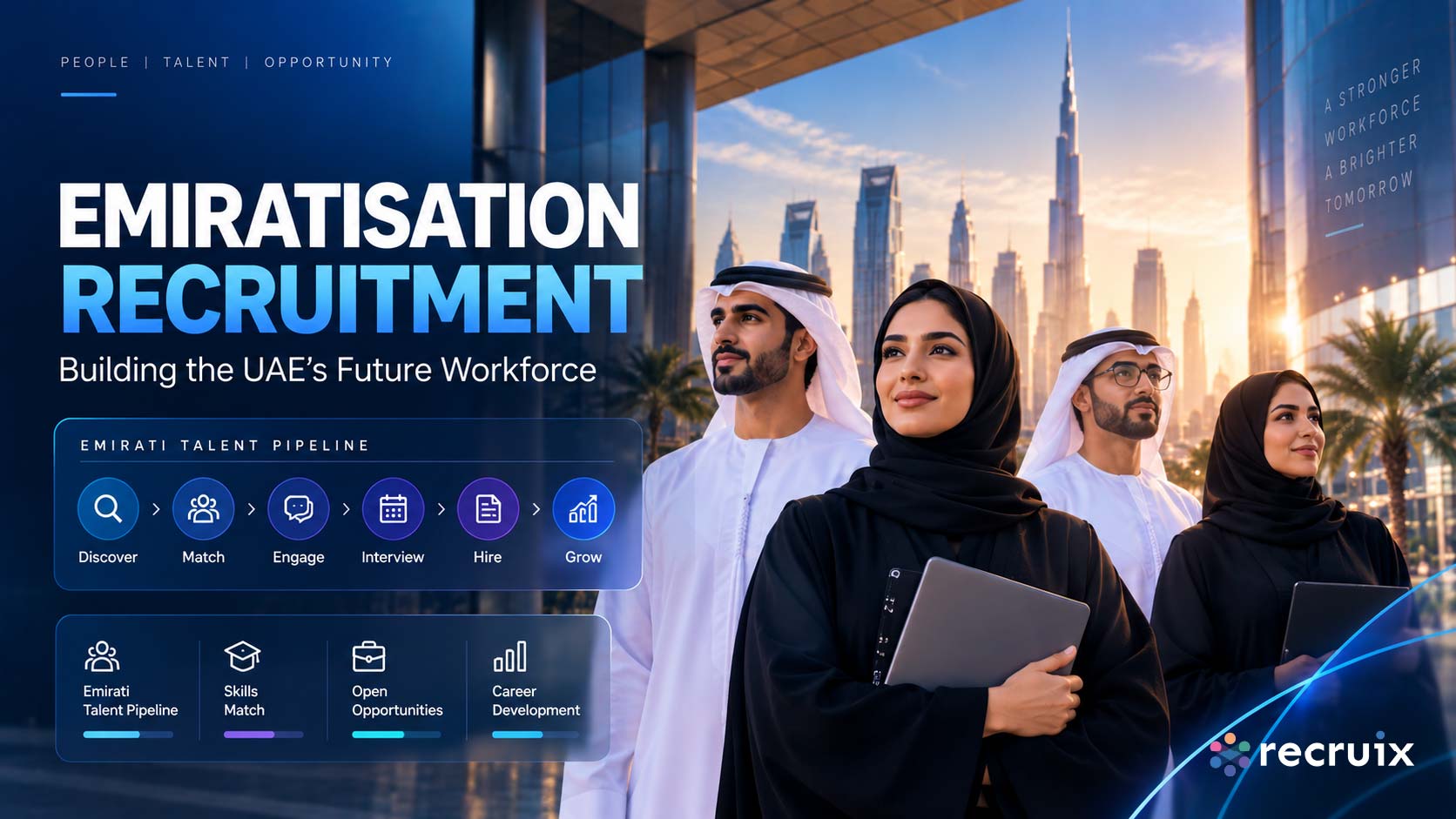
Emiratisation is changing the way many organisations in the UAE think about recruitment.
For employers, the challenge is no longer simply finding candidates when a vacancy becomes available. Building a sustainable Emirati workforce requires organisations to identify relevant talent, develop long-term candidate pipelines, understand skills and experience, engage candidates effectively, coordinate hiring teams, and maintain visibility across the recruitment process.
This makes Emiratisation not only a workforce objective, but also a talent acquisition challenge.
Technology can help.
Modern recruitment platforms can help organisations build searchable candidate databases, create dedicated talent pipelines, match candidates with suitable opportunities, automate repetitive recruitment tasks, coordinate approvals, and analyse hiring activity.
However, recruitment technology does not replace the Ministry of Human Resources and Emiratisation (MoHRE), Nafis, or any statutory UAE employment process.
Instead, it can provide the recruitment infrastructure organisations use internally to find, engage, evaluate and hire Emirati talent more effectively.
This guide explains how UAE companies can build a smarter Emiratisation recruitment strategy in 2026 and where recruitment technology, data and AI can support that strategy.
What Is Emiratisation?
Emiratisation is a UAE national workforce initiative designed to increase the participation of Emirati citizens in the labour market, including employment within the private sector.
The initiative forms part of the UAE's broader strategy to develop national talent and expand opportunities for UAE nationals across different sectors of the economy.
The Ministry of Human Resources and Emiratisation (MoHRE) oversees applicable Emiratisation requirements within the private sector.
The UAE Government also operates Nafis, a federal programme designed to support Emirati participation and competitiveness in the private sector.
Because Emiratisation requirements can change, employers should always verify current obligations through MoHRE and official UAE Government sources.
What Are the Emiratisation Requirements in 2026?
Emiratisation requirements depend on factors including the size and classification of the establishment and the applicable rules in force.
According to current MoHRE guidance, establishments with 50 or more employees are required to progressively increase Emiratisation in skilled jobs, with the applicable framework targeting a 10% Emiratisation rate by the end of 2026.
Requirements also apply to certain establishments with 20 to 49 employees operating within specified economic activities.
Because eligibility, calculations, deadlines and applicable requirements may change, organisations should always verify their current obligations directly through MoHRE.
The Official Platform of the UAE Government also provides current information about employing Emiratis in the private sector.
For recruitment leaders, however, understanding regulatory requirements is only the beginning.
The operational question is:
How does an organisation consistently attract, identify, engage and hire the Emirati talent it needs?
What Is an Emiratisation Recruitment Strategy?
An Emiratisation recruitment strategy is a structured approach to attracting, engaging, evaluating, hiring and developing UAE national talent in alignment with an organisation's workforce requirements.
A strong strategy should go beyond opening vacancies shortly before a hiring requirement becomes urgent.
It should help the organisation understand:
Which roles can provide meaningful opportunities for Emirati professionals
Which skills the organisation needs now and in the future
Where relevant Emirati candidates can be sourced
Which candidates already exist within the organisation's talent database
How candidates progress through recruitment pipelines
Where candidates are dropping out of the process
How quickly hiring teams respond to applicants
Which departments have upcoming workforce requirements
How recruitment activity contributes to longer-term workforce planning
This turns Emiratisation recruitment from a reactive hiring exercise into an ongoing talent strategy.
Why Can Emiratisation Recruitment Be Challenging?
Hiring UAE national talent can involve many of the same challenges found in other competitive talent markets.
Organisations may be competing for candidates with particular qualifications, industry experience or specialist skills. Candidate expectations can also differ according to career stage, profession, sector and individual objectives.
Internal recruitment processes can create additional challenges.
For example:
Candidate information may be distributed across spreadsheets and recruiter inboxes
Previous Emirati applicants may be difficult to rediscover
Recruiters may not have visibility into suitable candidates held by other departments
Hiring managers may take too long to provide feedback
Approval workflows may delay recruitment
Candidate communication may be inconsistent
Management may lack clear pipeline analytics
Solving these issues requires more than sourcing additional CVs.
It requires better recruitment infrastructure.
1. Build a Dedicated Emirati Talent Pipeline
Organisations should not begin searching for Emirati candidates only when an urgent vacancy appears.
A stronger approach is to develop an ongoing talent pipeline.
Potential candidates can enter this pipeline through channels such as career portals, recruitment campaigns, referrals, university initiatives, job fairs, approved recruitment channels, professional networks and previous applications.
Once candidates enter the organisation's recruitment environment, their profiles can remain searchable for appropriate future opportunities, subject to applicable data protection requirements and organisational policies.
This allows recruitment teams to move from:
Vacancy → Start Searching → Find Candidates
towards:
Build Talent Pipeline → Understand Talent → Match Candidates When Opportunities Arise
The second approach creates a more sustainable recruitment model.
2. Create a Searchable UAE National Candidate Database
A candidate database becomes increasingly valuable as recruitment activity grows.
Consider an Emirati professional who applies for a finance role but is not selected because another candidate has more relevant experience.
Six months later, another suitable finance position becomes available.
If the original application exists only in an old recruiter inbox or spreadsheet, the organisation may start sourcing again from zero.
With a structured candidate database, recruiters can rediscover that candidate quickly.
A modern Applicant Tracking System (ATS) can help centralise candidate information and recruitment history so recruiters can search existing talent before beginning an entirely new sourcing exercise.
For Emiratisation recruitment, this helps organisations build institutional knowledge of the Emirati talent they have already engaged with.
3. Structure Candidate Information Instead of Storing Only CVs
A folder containing thousands of CV files is not the same as a usable talent database.
Recruiters need structured information.
CV parsing technology can extract relevant information from candidate documents and organise it into searchable candidate profiles.
Depending on the information available, this may include:
Professional experience
Skills
Education
Qualifications
Job titles
Industry experience
Employment history
Contact information
This makes it easier for recruiters to identify potentially relevant candidates without manually opening every CV.
4. Match Emirati Candidates With Relevant Opportunities
One of the biggest opportunities in Emiratisation recruitment is improving the connection between candidates and appropriate jobs.
Hiring should not simply be about placing a UAE national into any available vacancy.
Sustainable recruitment requires stronger alignment between the candidate's capabilities, interests and experience and the requirements of the role.
This is where AI candidate matching can support recruiters.
Instead of searching exclusively for exact keywords, candidate matching technology can analyse multiple dimensions of candidate and job information.
Depending on the platform, these can include:
Skills
Relevant experience
Qualifications
Education
Industry background
Role requirements
Career history
The purpose is not to allow AI to decide who should be hired.
It is to help recruiters identify potentially relevant candidates who deserve closer human review.
5. Use AI to Support Skills-Based Recruitment
AI can support Emiratisation recruitment by helping recruiters analyse candidate information, compare profiles with job requirements and prioritise potentially relevant talent for human review.
This can become particularly useful when recruitment teams manage hundreds or thousands of candidate profiles.
For example, imagine an organisation creates a new cybersecurity vacancy.
Rather than sourcing from zero, the recruitment team could first search its existing talent database for Emirati candidates whose skills, education or previous experience may align with the position.
AI-assisted matching can help identify those candidates faster.
Recruiters can then review the underlying candidate information, contact appropriate candidates and make the actual recruitment decisions.
This follows the broader principle discussed in our guide to AI in recruitment: AI should support recruiter intelligence rather than remove human judgement from hiring.
6. Improve the Emirati Candidate Experience
Recruitment is a two-way decision.
Companies evaluate candidates, but candidates also evaluate companies.
A talented candidate may be considering several opportunities simultaneously.
Long application forms, unclear job information, delayed communication, repetitive requests for information and slow interview feedback can damage candidate experience.
Organisations should therefore evaluate the complete recruitment journey:
Discover Opportunity → Apply → Screening → Recruiter Contact → Interview → Feedback → Offer → Onboarding
Every unnecessary delay creates an opportunity for the candidate to disengage.
Modern recruitment platforms can help by providing structured application journeys, automated acknowledgements, interview communication, status management and centralised candidate records.
7. Reduce the Time Between Application and Recruiter Response
Candidate experience is strongly influenced by what happens immediately after an application is submitted.
If recruiters receive hundreds of applications, manually opening and reviewing every CV can create significant delays.
AI-assisted resume screening can help recruitment teams process candidate information and identify potentially relevant applications for recruiter attention.
The objective should not be automatic rejection based solely on an unexplained AI score.
A stronger model is:
AI Analyses → AI Prioritises → Recruiter Reviews → Human Decides
This allows technology to assist with information processing while maintaining human oversight.
8. Give Hiring Managers Better Pipeline Visibility
Recruitment is rarely controlled by recruiters alone.
Hiring managers, department leaders, HR teams and other stakeholders may all participate in the process.
If those stakeholders rely on email chains and spreadsheets, recruitment can slow down considerably.
A structured recruitment platform can provide authorised stakeholders with visibility into:
Open vacancies
Candidate pipelines
Shortlisted candidates
Interview stages
Pending feedback
Approval requirements
Offer status
This is particularly valuable for organisations managing Emiratisation recruitment across multiple departments or business units.
9. Track Emiratisation Recruitment With Analytics
Recruitment analytics can help organisations understand how Emirati candidates move through the hiring process and where recruitment bottlenecks may exist.
Depending on organisational requirements and lawful data handling, useful recruitment metrics can include:
Relevant candidates within the talent database
Applications by vacancy
Candidate sources
Shortlisting rates
Interview progression
Offer activity
Hiring activity
Time-to-hire
Recruiter activity
Department-level recruitment activity
These operational recruitment metrics are different from official Emiratisation calculations.
Employers should rely on MoHRE and applicable official systems for regulatory requirements and official calculations.
Internal recruitment analytics instead help HR leaders understand the effectiveness of their talent acquisition process.
10. Rediscover Emirati Talent Already in Your ATS
One of the most underused sources of candidates may already exist inside the organisation.
Companies can accumulate thousands of candidate records over several years.
Some candidates may have:
Applied for previous vacancies
Reached final interview stages
Been considered for another department
Joined a talent community
Been referred previously
When a new vacancy appears, recruiters should be able to search this existing talent before relying entirely on new sourcing.
AI candidate matching can make this process more useful by comparing existing candidate profiles against newly created vacancies.
This practice is often referred to as talent rediscovery.
For organisations developing long-term Emiratisation strategies, talent rediscovery can turn historical recruitment activity into a reusable talent asset.
11. Build Talent Communities, Not Just Applicant Lists
Not every promising candidate is ready to move jobs immediately.
And not every candidate who engages with an organisation will match the vacancy available at that particular moment.
That does not mean the relationship has no future value.
Recruitment teams can build talent communities around areas such as:
Technology
Finance
Engineering
Operations
Sales
Customer service
Graduate opportunities
Leadership roles
When suitable opportunities become available, recruiters have a relevant pool of candidates with whom the organisation has already established a connection.
12. Connect Emiratisation Recruitment With Workforce Planning
Recruitment becomes more effective when organisations understand future workforce requirements before vacancies become urgent.
HR and business leaders can work together to identify:
Roles expected to grow
Skills that may become difficult to recruit
Departments with future hiring requirements
Potential graduate and early-career opportunities
Roles where internal development may be appropriate
Recruitment teams can then begin developing relevant talent pipelines earlier.
This changes Emiratisation from a short-term recruitment response into part of broader workforce planning.
How Can Recruitment Software Support Emiratisation?
Recruitment software can support Emiratisation by helping organisations manage Emirati candidate pipelines, structure candidate information, match talent with jobs, coordinate recruitment workflows and analyse internal hiring activity.
It can provide the technology layer connecting:
Candidate Discovery → Candidate Database → Screening → Matching → Shortlisting → Interviews → Approvals → Offers → Hiring
Useful capabilities can include:
Central candidate database
CV parsing
Candidate search and filtering
AI-assisted candidate matching
AI-assisted screening
Talent rediscovery
Recruitment pipelines
Interview management
Hiring manager collaboration
Approval workflows
Offer management
Recruitment analytics
Career portals
Automated candidate communication
Our guide to recruitment software in the UAE explains the broader technology capabilities UAE organisations should consider when evaluating recruitment platforms.
Can AI Help With Emiratisation Recruitment?
Yes. AI can support selected parts of Emiratisation recruitment, particularly candidate information processing, skills-based matching, screening assistance and talent rediscovery.
However, AI should not be treated as a substitute for a recruitment strategy.
AI cannot create meaningful career opportunities, build an employer brand, conduct a human interview, understand every element of organisational context, or replace relationships between candidates and employers.
Its strongest role is helping recruiters process and understand information more efficiently.
For example, an organisation may have 20,000 candidates in its database.
A recruiter cannot realistically remember every candidate.
When a new position becomes available, AI-assisted matching can analyse the database and surface potentially relevant candidates.
The recruiter can then evaluate those candidates in context.
Should AI Automatically Reject Candidates?
Organisations should be cautious about allowing AI to make consequential recruitment decisions without appropriate human oversight.
A candidate may have transferable experience or contextual strengths that are not perfectly represented in a CV.
Recruiters should therefore be able to understand why a system considers one candidate more relevant than another.
Useful AI-assisted recruitment systems should aim to provide information such as:
Matching skills
Relevant experience
Qualifications
Potential gaps
Job requirement alignment
The recruiter can then consider that information alongside interviews, assessments, organisational requirements and other relevant factors.
Does Recruitment Software Replace Nafis?
No. Recruitment software does not replace Nafis.
Nafis is a UAE federal programme supporting Emirati participation and competitiveness in the private sector.
An ATS or recruitment platform serves a different purpose.
It helps an employer manage its internal recruitment activities, candidate database, jobs, recruitment workflows and hiring process.
Does an ATS Replace MoHRE?
No. An Applicant Tracking System does not replace MoHRE or statutory employment processes.
MoHRE is the competent federal authority responsible for regulating labour relations in the UAE private sector and administering relevant employment services and requirements.
Recruitment software operates inside the employer's talent acquisition process.
A simple distinction is:
ATS / Recruitment Software: Manages candidates and internal recruitment workflows.
MoHRE / UAE Government Systems: Manage applicable statutory employment and government processes.
How Can Companies Measure Their Emirati Talent Pipeline?
Companies can use recruitment analytics to understand their internal talent acquisition pipeline while keeping this separate from official regulatory reporting.
A recruitment dashboard can help authorised teams understand:
How many candidates are currently active
Which jobs they are associated with
Which recruitment stages contain the most candidates
How many candidates have reached interviews
Where recruitment delays occur
Which candidate sources generate relevant applicants
How long candidates remain at each stage
Which departments have active recruitment requirements
This allows recruitment leaders to identify operational issues before they become larger hiring problems.
How Recruix Supports UAE National Recruitment Workflows
Recruix is an AI-powered recruitment platform and Applicant Tracking System designed to help organisations manage candidates and recruitment workflows from job requisition through hiring and onboarding.
For organisations building structured UAE national talent pipelines, Recruix provides recruitment capabilities including:
Centralised candidate management
CV parsing
Candidate search
AI-assisted candidate matching
AI-assisted candidate ranking
Talent rediscovery
Configurable recruitment pipelines
Job requisition workflows
Multi-level approvals
Interview management
Offer workflows
Role-based permissions
Recruitment analytics
Career portals
Automated communication
Enterprise integrations
The objective is not to replace the recruiter.
It is to give recruitment teams better information, structured workflows and intelligent tools so they can spend less time on repetitive administration and more time engaging candidates and making informed hiring decisions.
Organisations can also explore Recruix's AI Hiring Intelligence to understand how AI can support candidate discovery and recruitment decision-making.
Frequently Asked Questions About Emiratisation Recruitment
What is Emiratisation recruitment?
Emiratisation recruitment is the process of attracting, identifying, evaluating and hiring UAE national talent as part of an organisation's broader workforce and Emiratisation strategy.
Who is responsible for Emiratisation in the UAE private sector?
The Ministry of Human Resources and Emiratisation (MoHRE) is the competent federal authority for private-sector labour relations and applicable Emiratisation requirements. Employers should consult MoHRE and official UAE Government sources for current requirements.
What is Nafis?
Nafis is a UAE federal programme designed to support the participation and competitiveness of Emirati citizens in the private sector through a range of initiatives and services.
How can companies recruit more Emirati talent?
Companies can strengthen Emirati recruitment by developing long-term talent pipelines, improving candidate experience, building searchable candidate databases, engaging candidates earlier, matching skills to suitable opportunities, reducing recruitment delays and using recruitment analytics to understand their hiring process.
Can an ATS support Emiratisation recruitment?
Yes. An ATS can help organisations manage candidate records, vacancies, applications, recruitment pipelines, interviews, approvals, offers and analytics. Where configured appropriately, these capabilities can support an organisation's internal Emirati talent acquisition process.
Can AI help identify suitable Emirati candidates?
AI-assisted recruitment technology can help recruiters analyse candidate information and compare profiles with job requirements. Recruiters should review the underlying candidate information and retain appropriate human oversight over recruitment decisions.
Can recruitment software track Emiratisation targets?
Recruitment software can provide internal recruitment analytics and visibility where configured for an organisation's requirements. Official Emiratisation calculations, obligations and reporting should be determined through MoHRE and applicable UAE Government systems and guidance.
Does Recruix integrate with Nafis?
Organisations should not assume a direct Nafis integration unless such an integration is specifically documented and available. Recruix supports internal recruitment workflows and candidate management, while Nafis remains a separate UAE Government programme and platform.
Does recruitment software replace MoHRE?
No. Recruitment software manages internal talent acquisition activities. MoHRE and other applicable UAE Government systems remain responsible for statutory employment processes and regulatory requirements.
Is Emiratisation only about meeting recruitment targets?
No. A sustainable Emiratisation strategy can also involve talent development, career progression, skills development, retention and long-term workforce planning. Recruitment is one part of that broader strategy.
Building a Sustainable Emirati Talent Strategy
Successful Emiratisation recruitment should not begin when an organisation realises it urgently needs additional UAE national hires.
The stronger approach is to continuously build relationships with talent.
That means creating structured candidate databases, understanding skills, developing talent pipelines, improving candidate experiences, identifying future workforce requirements and giving recruiters technology that helps them rediscover relevant candidates when opportunities appear.
AI can strengthen this process by helping recruitment teams analyse larger amounts of candidate information and identify potentially relevant talent more efficiently.
But technology is only an enabler.
Successful Emiratisation ultimately depends on organisations creating meaningful opportunities, engaging Emirati professionals effectively, developing talent and building workplaces where UAE nationals can establish long-term careers.
For official information about Emiratisation requirements, organisations should continue to consult MoHRE, the Official Platform of the UAE Government, and Nafis.
Build a Smarter UAE National Talent Pipeline With Recruix
See how Recruix can help your recruitment team build structured candidate pipelines, rediscover talent, use AI-assisted candidate matching, automate recruitment workflows and gain better visibility across the hiring journey.
The Recruix team shares practical guidance for smarter, more effective hiring.
Stay Ahead of the Future of Hiring
Get recruitment insights, AI hiring trends, and workforce intelligence delivered directly to your inbox.
Ready to Transform Your Hiring Process?
See how Recruix helps organizations hire smarter through AI-powered recruitment intelligence.
Book Demo