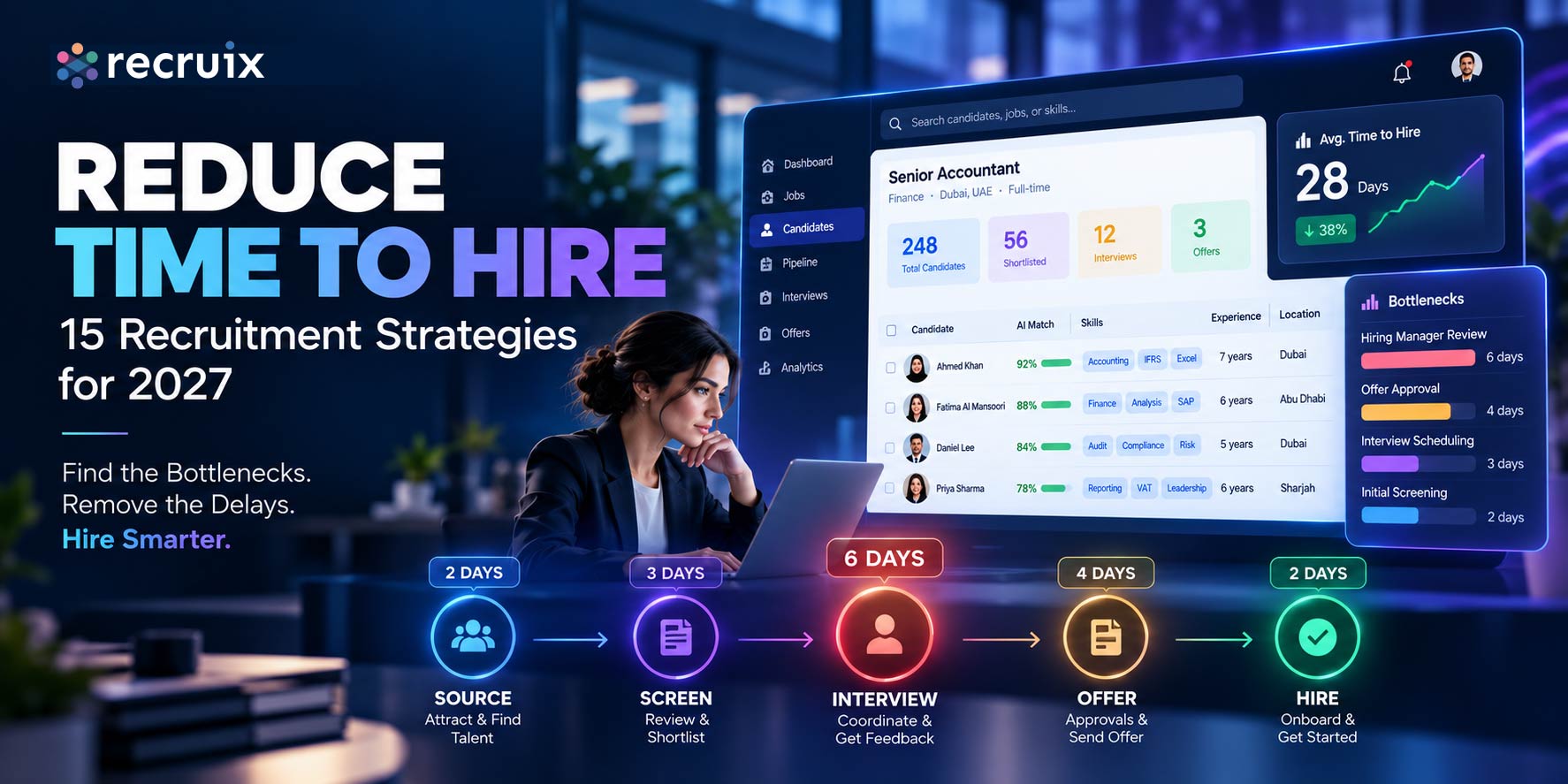
When a strong candidate enters your recruitment pipeline, the clock starts ticking.
They may be interviewing with several employers. Hiring managers may be waiting for critical positions to be filled. Recruiters may be managing hundreds of applications across multiple vacancies. Meanwhile, every unnecessary approval, delayed interview, manual screening task and unanswered email can add time to the hiring process.
That is why reducing time to hire remains an important priority for recruitment teams planning for 2027.
But faster hiring should not mean careless hiring.
The objective is not to make every hiring decision as quickly as possible. It is to remove unnecessary delays while preserving the evaluation, collaboration and human judgement required to make good hiring decisions.
This guide explains how to measure time to hire, how it differs from time to fill, where recruitment delays typically occur, and 15 practical strategies organisations can use to build a faster and more efficient hiring process.
What Is Time to Hire?
Time to hire measures how long it takes a candidate who ultimately gets hired to move through your recruitment process.
A common approach is to measure the number of days between the successful candidate entering the recruitment pipeline and accepting the job offer.
For example:
- Candidate applies: 10 January
- Candidate accepts offer: 30 January
- Time to hire: 20 days
Indeed describes time to hire as the period between the successful candidate applying and accepting a job offer.
Source: Indeed – Time to Fill vs. Time to Hire.
The important thing is consistency. Recruitment teams should define exactly when their measurement starts and ends and use the same definition when comparing roles, departments and reporting periods.
Time to Hire vs. Time to Fill: What Is the Difference?
Time to hire and time to fill are related recruitment metrics, but they measure different parts of the hiring process.
| Metric | Typical Starting Point | Ending Point | What It Helps Measure |
|---|---|---|---|
| Time to Hire | Successful candidate enters the recruitment pipeline | Candidate accepts the offer | Speed of the candidate's journey through recruitment |
| Time to Fill | Recruitment for the vacancy begins, such as requisition approval or job posting | Candidate accepts the offer | Overall time required to fill the vacancy |
Consider this example:
- Vacancy approved: 1 January
- Successful candidate applies: 10 January
- Offer accepted: 31 January
Using those dates:
Time to fill = 30 days
Time to hire = 21 days
The distinction matters because the two metrics can reveal different problems.
A long time to fill but relatively short time to hire may indicate that the organisation is struggling to attract or source suitable candidates.
A long time to hire after qualified candidates have already entered the pipeline may point toward screening delays, interview scheduling, hiring-manager feedback, approvals or offer processes.
Why Does Time to Hire Matter?
Recruitment speed affects more than the recruitment team.
Long hiring processes can affect:
- Candidate experience
- Recruiter workload
- Hiring-manager productivity
- Business capacity
- Vacancy costs
- Offer acceptance
- Competition for talent
SHRM's 2025 recruiting benchmarking research reported median time-to-fill of roughly a month and a half for both executive and nonexecutive roles. The same research highlighted continuing recruitment challenges including insufficient applicants, losing talent to competitors and candidate ghosting.
Source: SHRM – The State of Recruiting 2025.
However, speed should never be treated as the only measure of recruitment success.
A company that reduces hiring time but consistently hires unsuitable candidates has not improved recruitment.
Faster Hiring Does Not Automatically Mean Better Hiring
Time to hire is best treated as one indicator of recruitment health rather than the ultimate measure of recruitment performance.
Recruitment teams should consider it alongside metrics such as:
- Quality of hire
- Offer acceptance rate
- Candidate experience
- Source effectiveness
- Hiring-manager satisfaction
- Cost per hire
- Early employee retention
Indeed's recruitment metrics guidance similarly recommends looking across multiple measures including cost per hire, time to hire, offer acceptance, quality of hire and other recruitment indicators.
Source: Indeed – Recruitment Metrics for Hiring Teams.
The goal should therefore be:
Reduce avoidable recruitment delays while maintaining the controls required to make a good hiring decision.
Where Is Your Recruitment Process Losing Time?
Before attempting to make recruitment faster, identify where the delays actually occur.
A typical recruitment process might look like:
Requisition → Approval → Sourcing → Application → Screening → Shortlist → Interview → Feedback → Offer Approval → Offer → Acceptance
Every transition creates a potential bottleneck.
| Bottleneck | What You May Notice | Possible Cause |
|---|---|---|
| Requisition approval | Jobs remain pending for days | Too many approvers or unclear responsibility |
| Candidate sourcing | Few suitable candidates enter pipeline | Weak sourcing channels or narrow talent pool |
| CV screening | Large backlog of unreviewed applications | High volume and manual review |
| Hiring-manager review | Shortlisted candidates wait for feedback | No response deadline or unclear ownership |
| Interview scheduling | Several days spent finding availability | Manual calendar coordination |
| Interview process | Candidates complete excessive rounds | Unclear evaluation framework |
| Offer approval | Selected candidates wait for approval | Complex or manual approval chains |
| Candidate communication | Candidates repeatedly ask for updates | Manual or inconsistent communication |
Once recruitment teams know where time is being lost, they can improve the relevant stage instead of attempting to make every part of recruitment faster.
15 Ways to Reduce Time to Hire in 2027
1. Define the Role Properly Before Recruitment Begins
A surprising amount of recruitment delay begins before the vacancy is published.
If recruiters and hiring managers disagree about the ideal candidate, recruiters may source and screen people who were never likely to be approved.
Before opening the vacancy, agree on:
- Essential skills
- Preferred skills
- Required experience
- Qualifications or certifications
- Location requirements
- Salary or compensation parameters
- Interview stages
- Decision makers
- Target hiring timeline
A clear recruitment brief reduces unnecessary work later in the process.
2. Simplify Job Requisition Approvals
A vacancy cannot attract candidates while it is waiting for internal approval.
Review how many people genuinely need to approve a requisition.
Recruitment workflows should make it clear:
- Who needs to approve
- What information they need
- What approval level applies
- Who is currently holding the request
- How long the request has been waiting
For complex organisations, different departments, job levels or business units may legitimately require different approval structures. The objective is not to remove governance—it is to remove unnecessary waiting.
3. Build Talent Pipelines Before Vacancies Become Urgent
If candidate sourcing begins only when a position becomes urgent, recruitment teams immediately start behind schedule.
For frequently hired or difficult-to-fill positions, develop talent pipelines in advance.
These might include:
- Previous applicants
- Employee referrals
- Internal employees
- Career portal registrations
- Recruitment events
- Professional communities
- Previously sourced candidates
SHRM's recruiting research also points to growing use of internal talent marketplaces and the potential benefits of treating existing employees as a strategic source of talent.
Source: SHRM – The State of Recruiting 2025.
4. Search Your Existing Candidate Database Before Starting From Zero
Recruitment teams often have hundreds, thousands or even tens of thousands of candidate profiles accumulated from previous hiring.
When a new vacancy opens, search that database before assuming every candidate must come from a new advertisement.
For example, when a Senior Accountant vacancy opens, recruiters should be able to identify previous candidates with relevant accounting experience, qualifications, industry background and skills.
This approach is often referred to as candidate rediscovery.
Your existing candidate database should be treated as a sourcing channel, subject to appropriate privacy, consent and data-retention requirements.
5. Improve Candidate Sourcing Instead of Simply Increasing Applications
More applications do not necessarily create faster hiring.
If a recruiter receives 1,000 poorly matched applications, screening may take longer than reviewing 100 highly relevant candidates.
Measure which sources actually produce candidates who progress through the recruitment funnel.
Potential sources include:
- Career sites
- Job boards
- Employee referrals
- Recruitment agencies
- Professional networks
- Internal talent
- Previous applicants
- Direct sourcing
Source quality matters as much as application volume.
6. Use CV Parsing to Structure Candidate Information
Recruiters should not need to manually copy information from every CV into a recruitment system.
Resume or CV parsing can help convert candidate documents into structured information such as:
- Contact information
- Skills
- Employment history
- Education
- Qualifications
- Experience
Structured candidate information can make searching, filtering and reviewing large candidate volumes more manageable.
Learn more about AI resume screening.
7. Use AI-Assisted Matching to Prioritise Review
When hundreds of candidates apply for one vacancy, manually reading every CV in an arbitrary order can consume significant recruiter time.
AI-assisted candidate matching can help recruiters identify potentially relevant profiles based on job requirements and candidate information.
However, AI should support recruiter judgement rather than replace it.
A useful system should help recruiters understand why a candidate appears relevant—for example, matching skills, relevant experience or qualifications—rather than simply displaying an unexplained score.
Read our guide to AI candidate matching beyond keyword matching.
8. Define Shortlisting Criteria Before Applications Arrive
If the definition of a strong candidate changes after recruiters begin screening, the team may need to review the same applicants multiple times.
Agree on essential and preferred criteria before applications arrive.
This can improve consistency between recruiters and hiring managers and reduce repeated screening work.
9. Give Hiring Managers Clear Feedback Deadlines
Recruiters cannot control time to hire alone.
A candidate may be shortlisted within hours but then wait several days for a hiring manager to review the profile.
Set practical service expectations, for example:
- Shortlist feedback within one or two business days
- Interview feedback within 24 hours
- Final hiring decision within an agreed period
The appropriate timeline will vary by organisation and role, but ownership should be clear.
10. Reduce Interview Scheduling Friction
Scheduling can become an invisible source of recruitment delay.
Several rounds of emails such as “Are you free Tuesday?” and “Can we move it to Wednesday?” can add days without improving the quality of the hiring decision.
Calendar integrations, shared availability and automated scheduling workflows can reduce administrative coordination.
11. Review Whether Every Interview Stage Is Necessary
More interview rounds do not automatically produce better hiring decisions.
For each stage, ask:
What information will this interview provide that we do not already have?
If two stages evaluate exactly the same criteria, consider whether they can be combined.
Different roles may still require different interview processes. A senior executive, graduate, engineer and high-volume frontline employee should not automatically pass through identical workflows.
12. Use Structured Interview Evaluation
Hiring decisions can slow down when interviewers evaluate candidates against different expectations.
Before interviews, define:
- Competencies being evaluated
- Questions or assessment areas
- Scoring approach
- Who evaluates each area
- How final feedback will be recorded
This helps make post-interview discussions more focused and reduces situations where stakeholders need another interview simply because important information was not collected earlier.
13. Automate Routine Candidate Communication
Recruiters should spend their time recruiting, not repeatedly writing the same administrative emails.
Appropriate recruitment communication can be automated or templated for events such as:
- Application acknowledgement
- Interview invitation
- Interview reminders
- Document requests
- Status updates
- Offer communication
Automation should not eliminate personal communication where human interaction matters. It should remove repetitive administration.
Explore recruitment automation.
14. Design Offer Approvals Before Reaching the Final Candidate
One of the worst times to discover that an offer needs four additional approvals is after the preferred candidate has already been selected.
Define offer approval rules in advance.
Depending on the organisation, approvals may vary by:
- Department
- Business unit
- Job level
- Salary
- Location
- Employment type
A structured approval workflow can preserve governance while giving recruiters visibility into exactly where an offer is waiting.
15. Measure Recruitment Stage Time, Not Just Total Time to Hire
A single number such as “time to hire = 32 days” tells you that recruitment took 32 days.
It does not tell you why.
Instead, measure time spent in individual stages.
| Stage | Example Time |
|---|---|
| Application → Initial Review | 2 days |
| Initial Review → Shortlist | 3 days |
| Shortlist → Hiring Manager Feedback | 6 days |
| Feedback → Interview | 4 days |
| Interview → Decision | 2 days |
| Decision → Offer Approval | 5 days |
| Offer → Acceptance | 3 days |
In this illustrative example, the biggest opportunities are obvious: hiring-manager feedback and offer approval.
Recruitment analytics become useful when they tell you where to act—not simply what happened.
Example: Redesigning a 45-Day Hiring Process
Consider a fictional company where the average hiring process takes approximately 45 days.
Its recruitment team discovers:
- Requisition approval frequently takes five days
- Recruiters manually review every CV
- Hiring managers take several days to review shortlists
- Interview scheduling happens through email
- Every role uses three interview rounds
- Offer approvals begin only after the final candidate is selected
The company redesigns the process by:
- Clarifying approval responsibility
- Searching existing talent pools before external advertising
- Structuring CV information
- Using AI-assisted matching to prioritise recruiter review
- Setting hiring-manager feedback expectations
- Using calendar-based interview scheduling
- Removing unnecessary interview stages
- Configuring offer approval workflows in advance
If those changes reduced the illustrative process from 45 days to 28 days, the improvement would not come from asking recruiters to “work faster.”
It would come from removing waiting time and repetitive administrative work.
This example is illustrative and is not a claim or guarantee that every organisation will achieve the same reduction.
Recruitment Bottleneck Diagnostic
| If You See This... | Investigate This... | Potential Improvement |
|---|---|---|
| Jobs take days to become active | Requisition approvals | Workflow and approval redesign |
| Not enough qualified candidates | Sourcing strategy | Talent pools and source optimisation |
| Too many CVs waiting | Screening process | Parsing, filtering and AI-assisted prioritisation |
| Strong candidates wait after shortlist | Hiring-manager response | Ownership and feedback SLA |
| Interviews take days to arrange | Scheduling | Calendar integration and automation |
| Candidates repeat similar interviews | Interview design | Structured evaluation and fewer redundant stages |
| Final candidates wait for offers | Offer approvals | Predefined approval workflows |
| No one knows where delays occur | Recruitment analytics | Stage-level time reporting |
A 30-Day Plan to Improve Time to Hire
Week 1: Measure
- Calculate current time to hire
- Calculate time to fill
- Measure time spent at each recruitment stage
- Identify roles with the longest hiring cycles
- Review candidate drop-off and offer acceptance
Week 2: Diagnose
- Meet recruiters and hiring managers
- Identify approval delays
- Review sourcing performance
- Review screening workload
- Identify manual administrative work
Week 3: Redesign
- Define recruitment ownership
- Simplify unnecessary approvals
- Set feedback expectations
- Review interview stages
- Create communication templates
- Define talent-pool and candidate-rediscovery processes
Week 4: Automate and Monitor
- Automate appropriate notifications and reminders
- Configure approval workflows
- Improve interview scheduling
- Introduce recruitment dashboards
- Begin reviewing stage-level metrics regularly
After implementation, compare results over several hiring cycles rather than judging success from a single vacancy.
Which Recruitment Metrics Should You Track Alongside Time to Hire?
Reducing time to hire should not happen in isolation.
Track a balanced set of recruitment indicators including:
- Time to hire
- Time to fill
- Time in stage
- Source effectiveness
- Applications per source
- Screen-to-interview conversion
- Interview-to-offer conversion
- Offer acceptance rate
- Cost per hire
- Candidate experience
- Hiring-manager satisfaction
- Quality of hire
Indeed's guidance on data-driven recruiting highlights the value of sourcing data, recruitment funnel metrics, application information and hiring KPIs when organisations analyse and improve their recruitment processes.
Source: Indeed – What Is Data-Driven Recruiting?.
How Recruitment Technology Can Help Reduce Hiring Delays
Technology cannot fix a poorly designed recruitment process by itself.
However, once an organisation understands its bottlenecks, recruitment technology can help reduce repetitive work and make workflows more visible.
Useful capabilities can include:
- Candidate databases
- Talent pools
- CV parsing
- AI-assisted candidate matching
- Candidate search and rediscovery
- Recruitment workflows
- Requisition approvals
- Interview coordination
- Automated communication
- Offer approvals
- Recruitment analytics
If you are currently evaluating recruitment technology, read our 2027 guide to choosing recruitment software.
How Recruix Supports More Efficient Recruitment Workflows
Recruix is an AI-powered recruitment platform and applicant tracking system designed to help organisations manage candidates, recruitment workflows and hiring processes in one environment.
Depending on an organisation's process, Recruix can support areas such as:
- Candidate management
- CV parsing
- AI-assisted candidate matching and ranking
- Candidate pipelines
- Requisition workflows
- Multi-level approvals
- Interview processes
- Recruitment communication
- Offer management
- Recruitment analytics
Explore AI Hiring Intelligence, Candidate Management and Recruitment Automation.
Time-to-Hire Improvement Checklist
Use this checklist when reviewing your recruitment process:
- Define time to hire consistently
- Measure time to fill separately
- Track time at each recruitment stage
- Identify your three biggest bottlenecks
- Agree job requirements before sourcing
- Review requisition approval times
- Build talent pools for recurring roles
- Search previous candidates
- Measure candidate-source quality
- Structure candidate information
- Use AI as a recruitment assistant, not an unexplained decision maker
- Set hiring-manager feedback expectations
- Reduce interview scheduling friction
- Remove redundant interview stages
- Use structured interview evaluation
- Automate repetitive candidate communication
- Configure offer approvals before final selection
- Track offer acceptance
- Measure quality alongside speed
- Review recruitment analytics regularly
Frequently Asked Questions
What is time to hire?
Time to hire measures how long the successful candidate spends moving through the recruitment process before accepting an offer. Organisations should define their starting point consistently so the metric can be compared reliably over time.
What is the difference between time to hire and time to fill?
Time to fill generally measures the period from the beginning of recruitment for a vacancy until an offer is accepted. Time to hire focuses on the successful candidate's journey from entering the recruitment pipeline until accepting the offer.
How can companies reduce time to hire?
Companies can reduce time to hire by identifying recruitment bottlenecks, improving candidate sourcing, searching existing talent pools, simplifying approvals, structuring screening, reducing interview scheduling delays, setting hiring-manager feedback expectations, automating repetitive administration and measuring time spent at each recruitment stage.
Does an ATS reduce time to hire?
An applicant tracking system can help reduce administrative delays by centralising candidate information and supporting workflows, communication, screening, interviews, approvals and reporting. However, technology alone will not fix unclear hiring requirements or inefficient recruitment processes.
Can AI reduce time to hire?
AI can assist recruiters with tasks such as CV processing, candidate matching, candidate search and prioritisation. It can help recruiters navigate large candidate volumes more efficiently, but important hiring decisions should retain appropriate human oversight.
What is a good time to hire?
There is no universal target that is appropriate for every organisation or vacancy. Hiring timelines vary by role complexity, seniority, candidate availability, industry and recruitment process. Organisations should benchmark relevant roles, monitor their own historical performance and focus on removing avoidable delays without sacrificing hiring quality.
How do you calculate time to hire?
A common calculation is the number of calendar days between the successful candidate entering the recruitment process and accepting the job offer. Whatever definition an organisation adopts, it should be applied consistently.
Why is my hiring process taking so long?
Common causes include slow requisition approvals, weak sourcing, high application volumes, manual screening, delayed hiring-manager feedback, interview scheduling, unnecessary interview stages, manual communication and slow offer approvals. Measuring time at each recruitment stage can reveal where the largest delays occur.
Should companies optimise only for faster hiring?
No. Recruitment speed should be considered alongside quality of hire, candidate experience, offer acceptance, hiring-manager satisfaction, cost and retention. Faster hiring is useful when the improvement comes from removing unnecessary delays rather than reducing the quality of evaluation.
Final Thoughts
Reducing time to hire does not mean rushing hiring decisions.
It means understanding where recruiters, hiring managers and candidates are waiting unnecessarily—and redesigning those parts of the process.
The strongest recruitment teams will not simply ask:
“How can we hire faster?”
They will ask:
“Where are we losing time, why is it happening, and which delays can we remove without compromising hiring quality?”
Start by measuring your recruitment stages. Find the bottleneck. Fix the process. Then use automation and recruitment technology where they genuinely remove repetitive work or waiting time.
If your organisation is reviewing its recruitment process for 2027, book a personalised Recruix demonstration. Bring one of your real hiring workflows and see how candidate management, AI-assisted matching, approvals and recruitment automation can support it.